Health
BMI Calculator
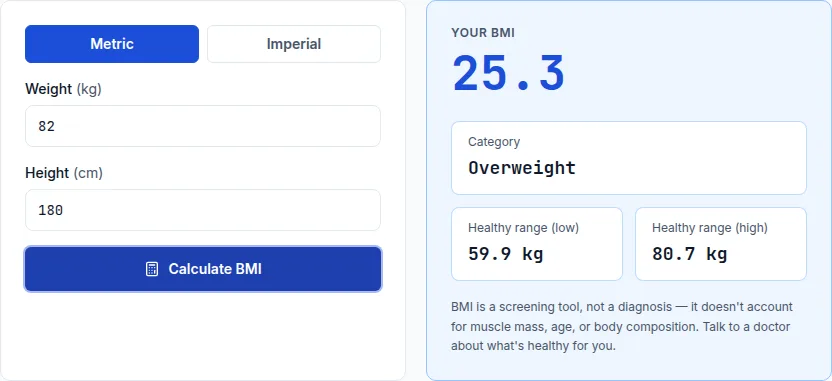
Check your body mass index in seconds using metric or imperial units. You'll see your BMI, which standard category it falls into, and the healthy weight range for your height.
Your BMI
22.9
Category
Normal weight
Healthy range (low)
56.7 kg
Healthy range (high)
76.3 kg
BMI is a screening tool, not a diagnosis — it doesn't account for muscle mass, age, or body composition. Talk to a doctor about what's healthy for you.
How it works
BMI (body mass index) estimates whether your weight is proportionate to your height. It divides weight by height squared — squaring the height accounts for the fact that taller people naturally weigh more.
The World Health Organization defines the standard adult categories: under 18.5 is underweight, 18.5–24.9 is normal weight, 25–29.9 is overweight, and 30+ is obesity. The healthy range shown is the weight span that would put your BMI between 18.5 and 24.9.
BMI is a population-level screening tool, not a diagnosis. It can't distinguish muscle from fat — athletes often score 'overweight' while being very lean — and it doesn't account for age, sex, or where fat is carried. Treat it as one data point among many.
Metric:   BMI = weight (kg) / height (m)²
Imperial: BMI = 703 × weight (lb) / height (in)²

Categories (WHO): <18.5 underweight · 18.5–24.9 normal
                  25–29.9 overweight · ≥30 obesity
When you'd use this
- Getting a quick screening number before or after a checkup.
- Tracking whether a weight-loss or fitness goal falls in a healthy range.
- Checking your healthy weight range for your exact height.
Frequently asked questions
How is BMI calculated?
BMI is weight in kilograms divided by height in meters squared. With imperial units, multiply weight in pounds by 703 and divide by height in inches squared. A 70 kg person who is 1.75 m tall has a BMI of 70 / 1.75² = 22.9.
What is a good BMI?
For most adults, the World Health Organization considers 18.5 to 24.9 a healthy range. Below 18.5 is classed as underweight, 25 to 29.9 as overweight, and 30 or above as obesity. Age isn't a factor for adults — a healthy BMI depends only on your height and weight.
Is BMI accurate for muscular people?
Not very. BMI can't tell muscle from fat — a lean, muscular person and someone with high body fat can land on the same BMI and get the same 'overweight' label despite very different health profiles. Waist circumference, body-fat percentage, and DEXA scans give a much better picture for athletic builds.
Does BMI work for children and teenagers?
The adult categories don't apply. For ages 2–19, BMI is compared against age- and sex-specific growth-chart percentiles instead. This calculator is designed for adults 20 and older.
What is a healthy weight for my height?
It's the weight range that keeps your BMI between 18.5 and 24.9 — for example, roughly 108–145 lb for someone 5'4", or 137–183 lb for someone 6'0". This calculator shows your exact healthy range once you enter your height.
From the blog
Related tools