Finance
Compound Interest Calculator
See what your money could grow into. Set a starting amount, optional monthly contributions, an interest rate, and a time horizon — the calculator shows your future balance and how much of it is pure interest.
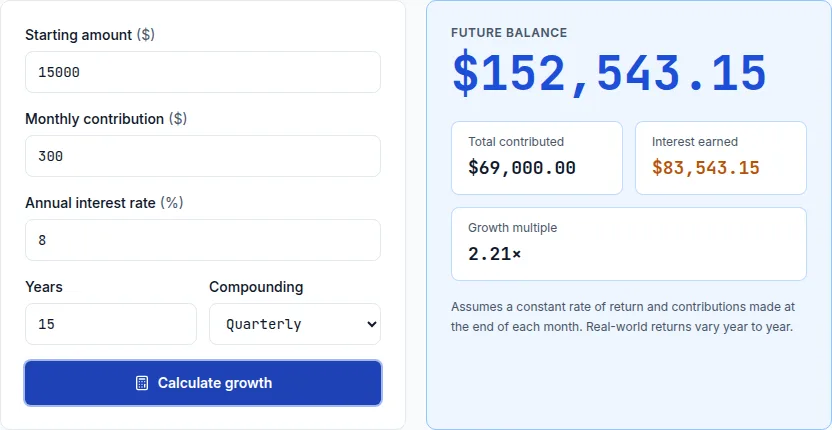
Future balance
$54,713.58
Total contributed
$34,000.00
Interest earned
$20,713.58
Growth multiple
1.61×
Assumes a constant rate of return and contributions made at the end of each month. Real-world returns vary year to year.
How it works
Compound interest means you earn interest on your interest. In year one you earn interest on your deposit; in year two you earn interest on the deposit plus year one's interest, and so on. Over long periods this snowballs — it's why starting early matters more than starting big.
The compounding frequency controls how often interest is added to the balance. Daily compounding grows slightly faster than annual compounding at the same stated rate, because interest starts earning interest sooner.
Monthly contributions are added at the end of each month and then compound from that point forward. The 'interest earned' figure is your final balance minus everything you put in — the money the market made for you.
A = P(1 + r/n)^(nt) + PMT × [((1 + i)^m − 1) / i]

A   = future balance
P   = starting principal
r   = annual rate (decimal),  n = compounds per year
t   = years,  m = months,  PMT = monthly contribution
i   = equivalent monthly rate = (1 + r/n)^(n/12) − 1
When you'd use this
- Projecting how a retirement or brokerage account balance could grow with regular contributions.
- Comparing two savings accounts with different rates or compounding frequencies.
- Figuring out how many years it will take to hit a specific savings goal.
Frequently asked questions
What is compound interest in simple terms?
Compound interest is interest earned on both your original money and on the interest it has already earned. Unlike simple interest, which only pays on the principal, compounding makes your balance grow faster and faster over time.
How often should interest compound for the best growth?
More frequent compounding grows faster at the same stated rate: daily beats monthly, which beats annually. The difference is real but modest — 7% compounded daily yields about 7.25% per year versus exactly 7% compounded annually.
What rate of return should I assume for investments?
For long-term stock market investing, 6–8% per year is a common historical assumption after inflation is ignored (the S&P 500 has averaged about 10% nominal). For savings accounts, use your bank's current APY. Remember that market returns are not guaranteed.
Do monthly contributions make a big difference?
Enormous. $200 a month at 7% for 30 years grows to roughly $235,000 — even though you only contributed $72,000. Regular contributions combined with compounding do most of the heavy lifting in long-term wealth building.
What is the Rule of 72?
A quick mental shortcut: divide 72 by your annual interest rate to estimate how many years it takes money to double. At 8%, money doubles roughly every 9 years; at 6%, about every 12 years.
From the blog
Related tools