
4 min read · February 2, 2027
Ideal Body Weight (Devine Formula) vs. BMI: Two Different Ways to Estimate a Healthy Weight
The Devine formula estimates ideal body weight from height alone using a simple per-inch increment, while BMI's healthy range comes from weight and height combined through the BMI formula — two different calculations that usually land in a similar ballpark but aren't the same number and were built for different purposes.
The Devine formula
Developed in 1974 for medication dosing, the Devine formula is: men, 50 kg + 2.3 kg per inch over 5 feet; women, 45.5 kg + 2.3 kg per inch over 5 feet. A 5'10" man: 50 + (2.3 × 10) = 73 kg, about 161 lb. It uses height only — no weight input at all, unlike BMI.
It was built specifically to estimate a reference weight for calculating drug dosages, particularly for medications where dosing by actual body weight would be inaccurate for people who are significantly over or under a 'typical' weight for their height — not originally intended as general fitness or wellness guidance, though it's since been widely adopted for that too.
How it compares to BMI's healthy range
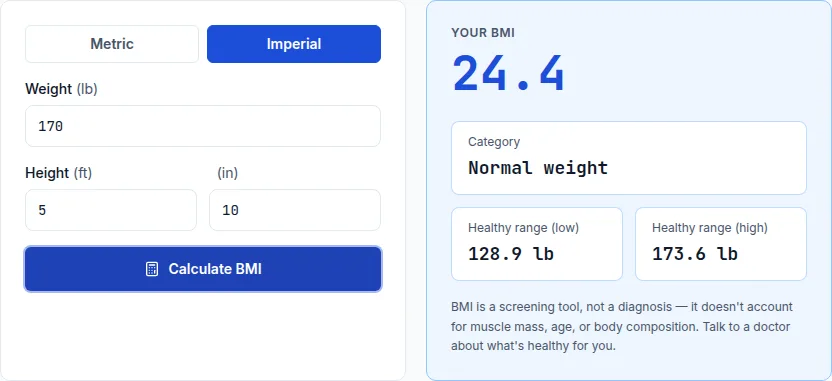
BMI's healthy range comes from a different direction entirely: it's whatever weight, at a given height, would produce a BMI between 18.5 and 24.9. For someone 5'10" (70 inches), that range is roughly 128.9–173.6 lb. The Devine estimate for a 5'10" man (161 lb) falls comfortably inside that BMI-derived range, which is typical — the two methods usually agree on the same rough neighborhood even though they're computed completely differently.
They diverge more at height extremes: Devine's linear per-inch formula and BMI's squared-height formula don't scale identically, so the gap between the two estimates tends to widen for people who are notably taller or shorter than average.
Which one to actually use
For general health screening, BMI's range is more widely validated and more commonly used by primary care — it's the one your doctor is likely referencing. Devine's formula remains mainly a clinical tool for dosing calculations (particularly for medications dosed by weight in a hospital setting) rather than a general wellness benchmark, despite its adoption in some fitness contexts.
Neither accounts for muscle mass, frame size, or body composition — both are population-level estimates, not individual verdicts, and both are best read as a starting range rather than a single 'right' number to hit exactly.
Related guides
Put it into practice
The fastest way to learn the math is to play with the numbers.
Open the BMI Calculator