
3 min read · November 2, 2027
Why BMI Says "Overweight" When You Know You're Not
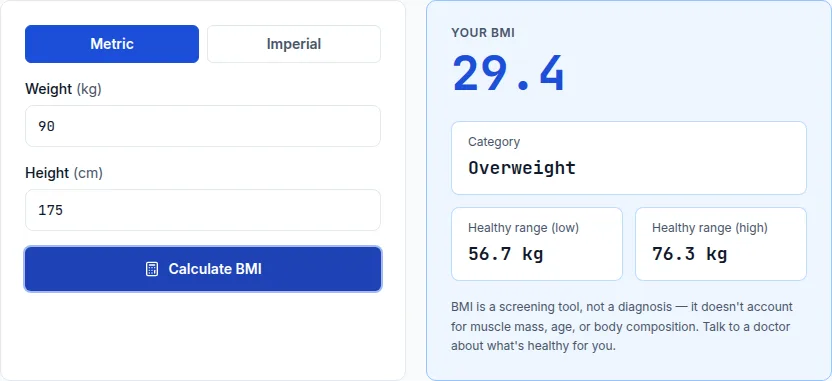
BMI can't tell muscle from fat — it only sees total weight relative to height. A 90 kg, 175 cm person with real muscle mass gets the exact same 'overweight' BMI of 29.4 as someone at the same weight and height carrying that weight as fat, even though those are two completely different bodies with completely different health profiles.
Why the formula can't see the difference
BMI is weight divided by height squared — one number in, one number out, with no way to know whether that weight is muscle, fat, bone density, or water. Muscle tissue is denser than fat tissue, meaning a genuinely lean, muscular person weighs more per unit of visible size than someone carrying the same weight as fat — and BMI has no mechanism to account for that difference at all.
This is exactly why athletes, people who lift weights seriously, and generally muscular people are the group most likely to see a BMI result that reads 'overweight' or even 'obese' while visibly not carrying excess fat — it's not a bug in a specific calculator, it's a structural limitation of the formula itself, the same everywhere it's used.
It's not just you — this is a known, documented limitation
This isn't a rare edge case: research and clinical discussion of BMI consistently flag muscle mass as its single biggest blind spot, to the point where 'BMI overestimates fatness in muscular individuals' is a standard caveat in most serious discussions of the metric, not a fringe complaint. If your BMI result doesn't match how you look, perform, or feel, that mismatch is a known, well-documented property of the formula — not a sign you're doing anything wrong.
The opposite problem exists too, less visibly: someone with very little muscle and a higher body-fat percentage can land in the 'normal' BMI range despite genuinely elevated health risk — a pattern sometimes called 'normal weight obesity.' BMI misses in both directions, not just the muscular-athlete direction.
What to check instead, if BMI doesn't fit your situation
Waist-to-height ratio, waist circumference alone, or an actual body-fat percentage measurement (skinfold calipers, bioelectrical impedance scales, or a DEXA scan for real precision) all capture something BMI structurally cannot: where the weight actually is and what it's made of, not just the total number on the scale relative to height.
BMI still has real value as a fast, free, zero-equipment population screening tool — it's just not the last word on an individual's health, and a muscular person getting an 'overweight' label from it is the formula working exactly as designed, not failing.
Related guides
Put it into practice
The fastest way to learn the math is to play with the numbers.
Open the BMI Calculator