
3 min read · May 11, 2027
BMI for Kids and Teens: Why the Adult Formula Doesn't Apply
The adult BMI categories (underweight under 18.5, normal 18.5–24.9, and so on) don't apply to anyone under 20 — children and teens are evaluated with BMI-for-age percentiles instead, comparing their BMI against other kids of the same age and sex, because normal, healthy BMI changes substantially as kids grow.
Why a fixed cutoff doesn't work for growing kids
A healthy BMI for a 6-year-old and a healthy BMI for a 16-year-old are genuinely different numbers, because body composition changes predictably through childhood and puberty. The fixed adult thresholds (18.5, 25, 30) were derived from adult health-outcome data and simply don't reflect what's typical or healthy at any given point in a child's growth curve.
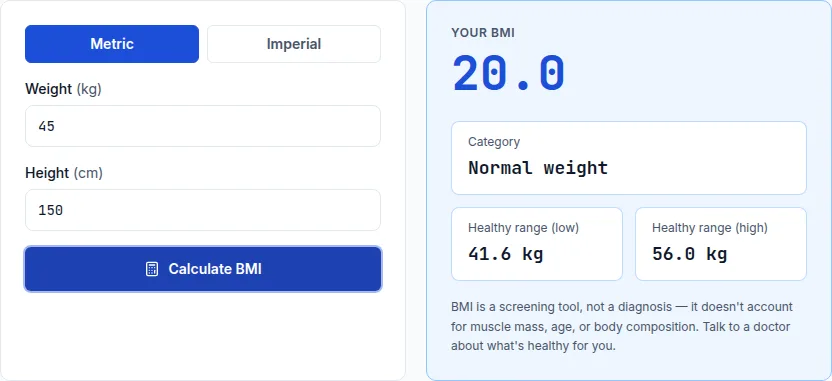
This calculator, like most general-purpose BMI calculators, is built and labeled for adults 20 and older specifically because of this — running a child's numbers through the adult categories produces a category label that isn't medically meaningful for them.
How the percentile system works instead
For ages 2–19, BMI is calculated the same way (weight ÷ height²) but then converted to a percentile using growth charts specific to age and sex — the percentile shows how a child's BMI compares to other children of the same age and sex, not to a fixed universal number. The CDC's categories: underweight is below the 5th percentile, healthy weight is 5th to under the 85th, overweight is 85th to under the 95th, and obesity is the 95th percentile or above.
A BMI number that would be 'normal' on the adult scale can land in a completely different percentile category for a child, and vice versa — which is exactly why using an adult BMI calculator on a child's numbers can produce a misleading label.
Where to get the right number
The CDC publishes a dedicated Child and Teen BMI Calculator built specifically around these age- and sex-specific percentiles, and it's the appropriate free tool for ages 2 through 19 — a pediatrician's office uses the same underlying growth-chart data at every well-child visit.
For anyone 20 or older, the standard adult BMI calculator and categories (like the one on this site) apply normally — the percentile system is specifically a childhood/adolescence concept tied to ongoing growth, not a lifelong replacement for the adult scale.
Related guides
Put it into practice
The fastest way to learn the math is to play with the numbers.
Open the BMI Calculator