Finance
Loan Calculator
Enter your loan amount, annual interest rate, and term to see the monthly payment, how much interest you'll pay over the life of the loan, and the total cost of borrowing.
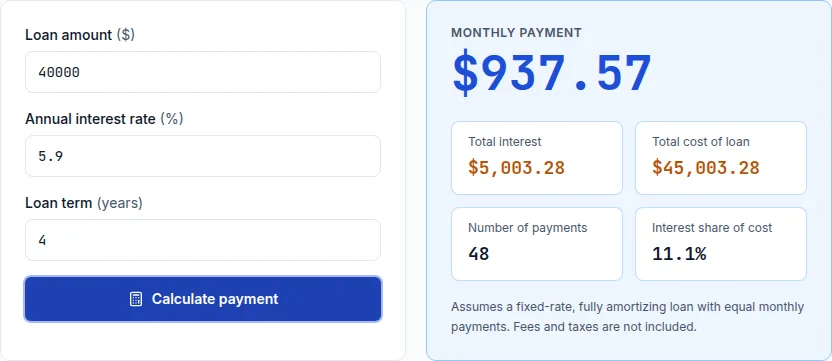
Monthly payment
$489.15
Total interest
$4,349.22
Total cost of loan
$29,349.22
Number of payments
60
Interest share of cost
14.8%
Assumes a fixed-rate, fully amortizing loan with equal monthly payments. Fees and taxes are not included.
How it works
This calculator uses the standard amortization formula that banks use for fixed-rate loans: car loans, personal loans, and most mortgages. Each monthly payment is the same amount, but the mix changes over time — early payments are mostly interest, later payments are mostly principal.
The annual rate is divided by 12 to get a monthly rate, and the term in years is multiplied by 12 to get the number of payments. The formula then finds the single payment amount that pays the balance down to exactly zero on the last payment.
Total interest is simply the sum of all payments minus the amount you borrowed — it's the true cost of the loan, which is why we highlight it in amber.
M = P × [ r(1+r)^n ] / [ (1+r)^n − 1 ]

M = monthly payment
P = loan amount (principal)
r = annual rate / 12 (monthly rate, as a decimal)
n = term in years × 12 (number of payments)
When you'd use this
- Comparing a car loan or personal loan quote from different lenders side by side.
- Deciding between a 15-year and 30-year mortgage term before applying.
- Checking how much extra principal payments would shrink total interest.
Frequently asked questions
How is a monthly loan payment calculated?
Monthly payments use the amortization formula M = P × [r(1+r)^n] / [(1+r)^n − 1], where P is the amount borrowed, r is the monthly interest rate (annual rate divided by 12), and n is the total number of monthly payments. This produces one fixed payment that fully pays off the loan by the end of the term.
Does this calculator work for mortgages?
Yes — the math is identical for any fixed-rate, fully amortizing loan, including mortgages. Just note that your real mortgage bill usually adds property taxes, homeowners insurance, and possibly PMI on top of the principal-and-interest payment shown here.
Why is my total interest so high?
Interest accrues on the outstanding balance every month, so longer terms mean many more months of interest. A 30-year loan can easily cost more in interest than a 10-year loan at the same rate — shortening the term or paying extra principal reduces total interest dramatically.
What's the difference between interest rate and APR?
The interest rate is the cost of borrowing the principal. APR (annual percentage rate) also folds in lender fees and certain closing costs, so it's usually slightly higher and better reflects the true yearly cost. This calculator uses the plain interest rate.
Can I pay off my loan faster by paying extra?
Yes. Extra payments go straight to principal, which shrinks the balance that interest is charged on. Even one extra payment per year on a long loan can cut years off the term and save thousands in interest — check that your lender doesn't charge prepayment penalties.
From the blog
Related tools