Everyday
Discount Calculator
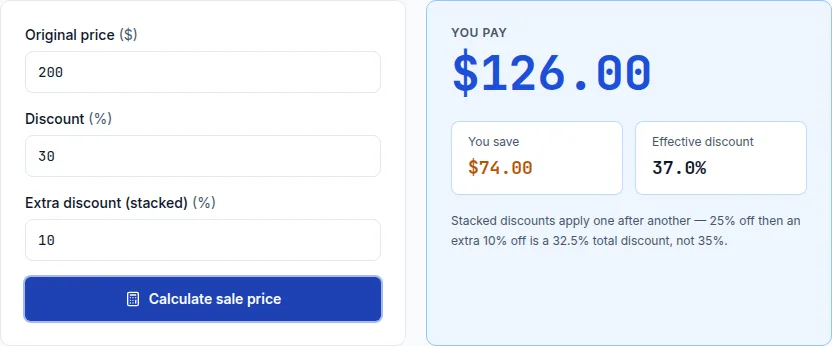
Find the real sale price before you get to the register. Enter the original price and the discount — plus an optional extra stacked discount — to see what you'll pay and exactly how much you save.
You pay
$90.00
You save
$30.00
Effective discount
25.0%
Stacked discounts apply one after another — 25% off then an extra 10% off is a 32.5% total discount, not 35%.
How it works
A discount reduces the price by a percentage of the original. 25% off $120 takes off 120 × 0.25 = $30, so you pay $90. The quick way: multiply the price by (1 − discount), so 25% off means paying 75% of the sticker price.
Stacked discounts — '25% off, plus an extra 10% at checkout' — apply one after the other, not added together. The extra 10% comes off the already-reduced $90, taking off $9, not $12. You pay $81, an effective 32.5% discount rather than 35%.
Retailers stack discounts precisely because the combined effect sounds bigger than it is. The effective-discount figure this calculator shows is the honest single percentage you're actually getting.
Sale price = price × (1 − d₁/100) × (1 − d₂/100)
Savings    = price − sale price

Example: $120 × 0.75 × 0.90 = $81  (32.5% effective, not 35%)
When you'd use this
- Checking the real price of an item during a store or online sale.
- Comparing two competing sales with different stacked discount structures.
- Working backward from a sale price to find the original price.
Frequently asked questions
How do I calculate a discount price?
Multiply the original price by the discount percentage to get the savings, then subtract. For 25% off $120: 120 × 0.25 = $30 saved, so the sale price is $90. Faster: multiply by (100 − discount)% directly — 120 × 0.75 = 90.
How do stacked or double discounts work?
Each discount applies to the price left after the previous one. 25% off plus an extra 10% means 120 × 0.75 = 90, then 90 × 0.90 = $81 — an effective 32.5% off, not 35%. Stacked discounts are always slightly less than their sum.
What does 'up to 70% off' actually mean?
It means at least one item in the sale is 70% off — most items are usually discounted much less. Check the per-item discount rather than the banner headline.
How do I calculate the original price from a sale price?
Divide the sale price by (1 − discount). If something costs $90 after 25% off, the original price was 90 ÷ 0.75 = $120.
Is 50% off the same as buy one get one free?
Only if you'd buy two anyway. BOGO gives an effective 50% off per item but forces you to take two; a straight 50% discount saves you money on a single item. For one item, 50% off is strictly better.
From the blog
Related tools