
6 min read · June 23, 2026
BMI Explained: What Your Number Means (and What It Doesn't)
BMI is the most used — and most argued about — health metric in the world. It's on every doctor's intake form, yet athletes routinely 'fail' it. Here's how the number works, what it can genuinely tell you, and where it misleads.
The calculation and categories
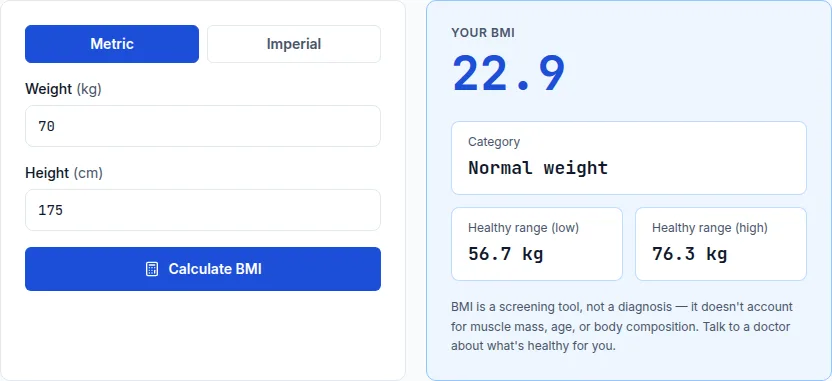
BMI divides your weight in kilograms by your height in meters squared. In imperial units, multiply weight in pounds by 703 and divide by height in inches squared. A 70 kg, 175 cm person scores 70 / 1.75² = 22.9.
The WHO's adult categories: below 18.5 is underweight, 18.5–24.9 normal, 25–29.9 overweight, and 30+ obesity. The height-squared denominator exists because weight naturally scales with height — without it, every tall person would look overweight on paper.
Why BMI is useful anyway
At the population level, BMI correlates well with body fat and with the risks that follow it — type 2 diabetes, cardiovascular disease, joint problems. It costs nothing to measure, needs no equipment, and gives doctors a fast screening signal that flags who might benefit from a closer look.
That's the key word: screening. BMI was never designed to diagnose an individual, and the researcher who created the underlying index — the Belgian statistician Adolphe Quetelet, in the 1830s — was studying populations, not patients.
Where BMI breaks down
BMI can't tell a kilogram of muscle from a kilogram of fat. Muscular athletes commonly register as 'overweight' at single-digit body-fat percentages, while a sedentary person can hold a 'normal' BMI with high visceral fat — the pattern sometimes called 'skinny fat'.
It also ignores age, sex, and fat distribution. Waist-carried visceral fat is far riskier than fat on the hips, which is why waist circumference (or waist-to-height ratio) is such a valuable companion metric: a waist under half your height is a widely used rule of thumb.
What to track instead — or alongside
For most people, BMI plus waist circumference covers the bases cheaply. If you train seriously, a body-fat estimate (DEXA scan, or even a decent smart scale trend line) tells you far more than BMI ever will. And regardless of any number, blood pressure, blood sugar, and lipid panels measure the outcomes that actually matter.
Related guides
Put it into practice
The fastest way to learn the math is to play with the numbers.
Open the BMI Calculator