Finance
ROI Calculator
Measure how well an investment performed. Enter the amount invested and the amount returned to see the total ROI percentage, your net gain or loss, and the annualized return that makes different holding periods comparable.
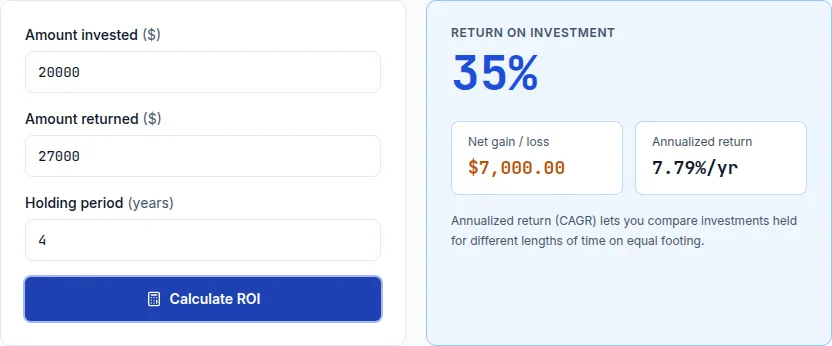
Return on investment
45%
Net gain / loss
$4,500.00
Annualized return
13.19%/yr
Annualized return (CAGR) lets you compare investments held for different lengths of time on equal footing.
How it works
ROI (return on investment) is the simplest performance measure: the profit divided by what you put in, expressed as a percentage. Invest $10,000, get back $14,500, and your ROI is 45% with a $4,500 net gain.
Plain ROI ignores time, which makes comparisons misleading — 45% over three years is very different from 45% over ten. That's what annualized return (CAGR, compound annual growth rate) fixes: it's the steady yearly rate that would produce the same result over the holding period.
A 45% total return over 3 years is a 13.2% CAGR. Comparing CAGRs lets you line up any investment against benchmarks like the stock market's historical ~10% nominal annual return.
ROI  = (returned − invested) / invested × 100

CAGR = ((returned / invested)^(1 / years) − 1) × 100

Example: ($14,500 − $10,000) / $10,000 = 45% ROI
         (1.45)^(1/3) − 1 = 13.2% per year
When you'd use this
- Checking how a stock, fund, or business investment actually performed once it's sold.
- Comparing a rental property's return against a stock market benchmark.
- Deciding whether a side project or business expense was worth the money and time.
Frequently asked questions
How is ROI calculated?
ROI is the net profit divided by the amount invested, times 100. If you invest $10,000 and it becomes $14,500, ROI = (14,500 − 10,000) / 10,000 × 100 = 45%.
What's the difference between ROI and annualized return (CAGR)?
ROI is the total return over the whole holding period, regardless of length. CAGR spreads that return into an equivalent constant yearly rate, which makes a 3-year and a 10-year investment directly comparable.
What is a good ROI?
Context is everything. The US stock market has historically returned about 10% per year before inflation, so an investment beating that with similar risk is doing well. For business projects, many companies want 15–30%+ to justify the risk and effort.
Can ROI be negative?
Yes — if you get back less than you invested, ROI is negative. Getting $8,000 back from a $10,000 investment is a −20% ROI and a $2,000 loss.
Should I include fees, taxes, and dividends in ROI?
For an accurate picture, yes. Add dividends and any income to the amount returned, and subtract transaction fees and taxes. Costs compound too — a 1% annual fee can eat a quarter of your gains over 30 years.
From the blog
Related tools