6 min read · July 7, 2026
ROI Made Simple: How to Measure Any Investment's Return
ROI is the universal language of money decisions — stocks, rental property, a business idea, even a kitchen renovation. The formula takes ten seconds; using it honestly takes a bit more thought.
The basic formula
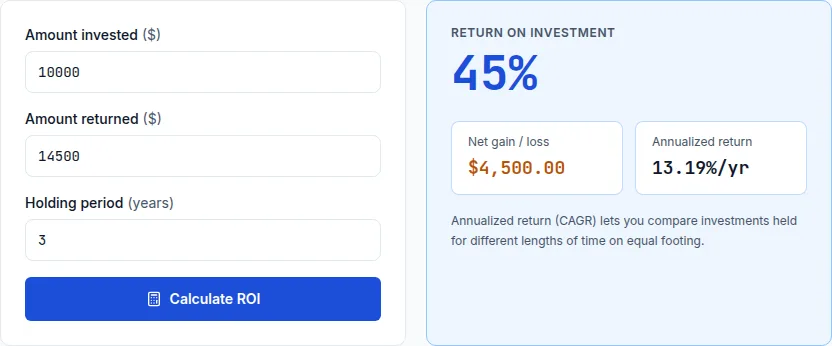
ROI = (amount returned − amount invested) / amount invested × 100. Put in $10,000, get back $14,500, and your ROI is 45% — a $4,500 net gain. Negative ROI works the same way: get back $8,000 and you're at −20%.
The 'amount returned' should include everything the investment paid you along the way: dividends, rent, interest — not just the final sale price.
Why time changes the picture
A 45% return sounds excellent — but over how long? In one year it's spectacular; spread over ten years it badly trails a boring index fund. Total ROI ignores time entirely, which makes it nearly useless for comparing investments of different lengths.
Annualized return (CAGR) fixes this: CAGR = (returned/invested)^(1/years) − 1. The 45% gain over 3 years is a 13.2% CAGR; over 10 years it's just 3.8%. Suddenly the comparison against the stock market's historical ~10% is easy — and revealing.
The costs people forget
Honest ROI subtracts every cost from the return: transaction fees, fund expense ratios, taxes on gains, and — for property — closing costs, insurance, maintenance, and vacancies. A rental that 'returns 12%' before expenses often nets closer to 6–8% after them.
Also easy to forget: your own time. If a side business returns 30% but consumes 500 hours a year, price those hours in before comparing it to a hands-off index fund.
What counts as a good ROI?
Benchmarks help: US large-cap stocks have returned roughly 10% a year over the last century (about 7% after inflation), investment-grade bonds 4–5%, and high-yield savings currently around 4%. An investment should beat the benchmark with comparable risk — otherwise the benchmark is the better buy.
For business decisions, hurdle rates of 15–30% are common because business projects carry execution risk that passive investments don't. The riskier the venture, the higher the return needed to justify it.
Related guides
Put it into practice
The fastest way to learn the math is to play with the numbers.
Open the ROI Calculator