5 min read · December 15, 2026
Cash-on-Cash Return: How to Measure a Rental Property's Real Yield
Cash-on-cash return is annual pre-tax cash flow divided by total cash actually invested, expressed as a percentage — a $60,000 down payment and closing costs that produces $4,200 a year in net rental cash flow is a 7% cash-on-cash return. It measures yield on the cash you put in, not the property's full value, which is exactly what makes it the metric real estate investors actually watch.
The formula and what counts as 'cash invested'
Cash-on-cash return = annual pre-tax cash flow ÷ total cash invested × 100. Total cash invested means every dollar that actually left your pocket up front: the down payment, closing costs, and any immediate repairs — not the property's purchase price, since most of that is financed by the mortgage, not paid in cash.
Annual pre-tax cash flow is rental income minus every operating expense and the mortgage payment, before any tax effects. A $250,000 property with a $50,000 down payment, $4,000 in closing costs, and $6,000 in repairs has $60,000 in cash invested; if it nets $4,200 a year after all expenses and the mortgage payment, that's a 7% cash-on-cash return.
Using a plain ROI calculator to get this number
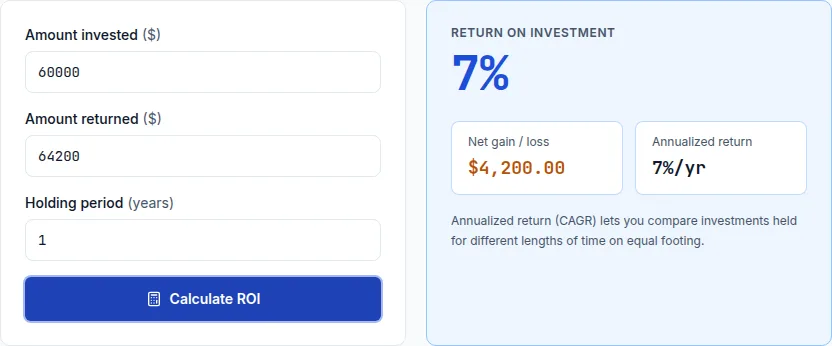
A standard ROI calculator computes (returned − invested) ÷ invested — which lands on exactly the cash-on-cash formula if 'amount invested' is your total cash invested and 'amount returned' is that same amount plus one year's net cash flow. Enter $60,000 invested and $64,200 returned ($60,000 + $4,200 cash flow), and the ROI% it shows is precisely your cash-on-cash return: 7%.
This works because cash-on-cash return and one-year ROI are the same calculation when there's no property sale involved — the 'return' is just cash flow, not appreciation or sale proceeds, which is what keeps this metric focused purely on how the property performs as an income-generating asset.
What counts as a good number
The commonly cited range is 8–12% for a solid cash-on-cash return, with anything above 10% considered strong in most markets. Below that, the property may still be a reasonable long-term hold if it's appreciating well or paying down the mortgage quickly, but as pure cash yield it's underperforming what many investors target.
Cash-on-cash return deliberately ignores appreciation and mortgage paydown — it's a cash-flow number, not a total-return number. A property with a mediocre cash-on-cash return can still be an excellent long-term investment once those other factors are added back in, which is why serious investors track it alongside, not instead of, total ROI.
Related guides
Put it into practice
The fastest way to learn the math is to play with the numbers.
Open the ROI Calculator