4 min read · November 10, 2026
ROI vs. ROAS: What's the Difference (and Which One Should You Use)?
ROAS (return on ad spend) is revenue divided by ad spend, ignoring every other cost. ROI (return on investment) is profit divided by total cost, including everything ROAS leaves out. A campaign can have an impressive ROAS and a mediocre or even negative ROI once the rest of the cost of doing business is counted.
What each metric actually includes
ROAS = revenue ÷ ad spend, and it stops there — no product cost, no shipping, no salaries, no platform fees. It's designed to answer one narrow question fast: is this specific ad campaign generating more revenue than it costs to run, before anything else is factored in.
ROI = (net profit) ÷ (total cost) × 100, and 'total cost' is meant to include everything: the ad spend, the cost of goods sold, fulfillment, returns, and any other expense tied to making the sale happen. It answers the broader question ROAS can't: is this campaign actually making the business money.
Why the same campaign can look great on one metric and bad on the other
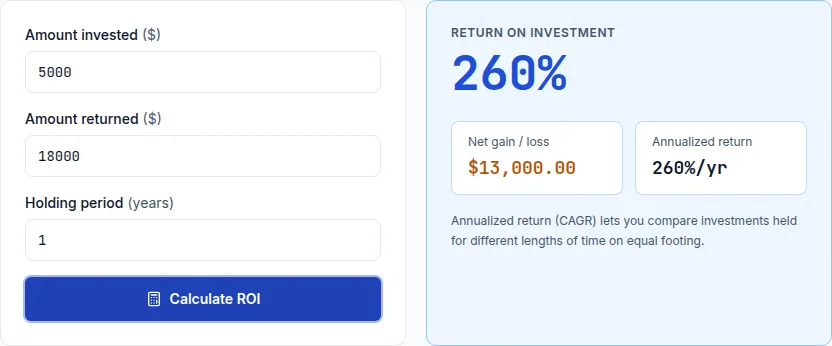
$5,000 in ad spend generating $18,000 in revenue is a 260% ROAS-style return by the loose 'revenue over spend' framing — that sounds outstanding. But if the product costs 60% of its sale price to make and ship, the real profit is closer to $7,200 (40% margin on $18,000) minus the $5,000 ad spend, for $2,200 in actual profit — a real ROI of $2,200 ÷ $5,000 = 44%, respectable but nowhere near as dazzling as '260%' sounds.
This gap is exactly why ROAS numbers reported in ad-platform dashboards can be misleading if treated as a profitability metric — they were never measuring profitability in the first place, just revenue efficiency relative to spend.
When to use which
ROAS is the right tool for fast, tactical decisions inside a single ad platform: which creative, audience, or channel is generating more revenue per dollar spent, checked daily or weekly. It's a relative comparison metric, best used to rank options against each other rather than as a standalone verdict on profitability.
ROI is the right tool for the actual business decision: should this channel keep getting budget at all, once every real cost is counted. Run both — ROAS to optimize which ads to scale, ROI to decide whether the whole channel is worth it.
Related guides
Put it into practice
The fastest way to learn the math is to play with the numbers.
Open the ROI Calculator