
3 min read · March 9, 2027
The Rule of 72, Explained (With Real Examples)
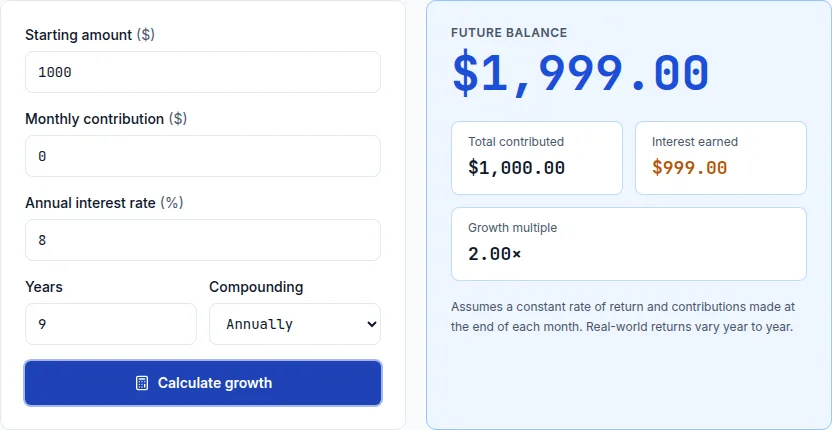
Divide 72 by an annual interest rate to estimate how many years it takes money to double at that rate — at 8%, that's 72 ÷ 8 = 9 years, and $1,000 growing at 8% annually actually reaches $1,999 after 9 years, confirming the estimate almost exactly.
The rule and why it works
Years to double ≈ 72 ÷ interest rate (as a whole number, not a decimal). At 6%: 72 ÷ 6 = 12 years. At 9%: 72 ÷ 9 = 8 years. At 12%: 72 ÷ 12 = 6 years. It's a fast mental-math approximation of the actual compound growth formula, accurate enough for real decisions without needing a calculator.
The rule is most accurate for rates between roughly 5% and 10% — at very high or very low rates, the underlying exponential math bends away from the simple 72-divided-by-rate approximation, though it stays a useful ballpark even outside that range.
It works on debt too — in the wrong direction
The same math applies to any compounding balance, including debt you owe. A $2,000 credit card balance at 12% interest, left untouched, doubles to $4,000 in about 72 ÷ 12 = 6 years — the identical mechanism that grows savings works just as relentlessly against an unpaid balance.
This is a genuinely useful way to feel the real cost of high-interest debt: a 22% APR credit card balance would double in about 72 ÷ 22 ≈ 3.3 years if no payments were made at all, a concrete number that's easier to internalize than an abstract percentage.
Beyond investing: inflation and any doubling question
The Rule of 72 works for anything that grows or shrinks by a fixed percentage rate repeatedly — inflation eroding purchasing power, for instance. At 4% inflation, prices roughly double (and your money's purchasing power roughly halves) in about 72 ÷ 4 = 18 years, a useful gut-check for long-term financial planning.
For a precise answer rather than an estimate, run the exact numbers through a compound interest calculator — the Rule of 72 is for fast mental math and sanity-checking, not for a final figure on something that actually matters financially.
Related guides
Put it into practice
The fastest way to learn the math is to play with the numbers.
Open the Compound Interest Calculator