
7 min read · June 9, 2026
Compound Interest: The Complete Beginner's Guide
Einstein probably never called compound interest the eighth wonder of the world, but the misattribution survives because the effect really is astonishing. Money that earns returns on its own returns grows exponentially — slowly at first, then suddenly.
Simple vs. compound interest
Simple interest pays only on your original deposit: $10,000 at 7% simple interest earns a flat $700 every year. Compound interest pays on the whole balance, including past interest: year one earns $700, year two earns $749, year three $801, and by year 30 you're earning over $5,000 a year without adding a cent.
After 30 years, that $10,000 becomes $31,000 with simple interest — but $76,000 with compounding. The entire difference is interest earned on interest.
The formula, decoded
The classic formula is A = P(1 + r/n)^(nt): P is your starting amount, r the annual rate as a decimal, n how many times per year interest compounds, and t the number of years. The exponent nt is what makes growth exponential rather than linear.
Compounding frequency matters less than people think. $10,000 at 7% for 10 years grows to $19,672 with annual compounding and $20,137 with daily compounding — a real but modest difference. The rate and the time horizon dominate everything else.
The Rule of 72
Divide 72 by your annual return to estimate the years needed to double your money. At 8%, money doubles every ~9 years; at 6%, every ~12. Over a 36-year career at 8%, your first contribution doubles four times — multiplying by 16.
That's also why starting early wins: a 25-year-old's dollar has time to double four times by 61; a 45-year-old's dollar only twice. The early saver can invest half as much and still retire with more.
Monthly contributions change everything
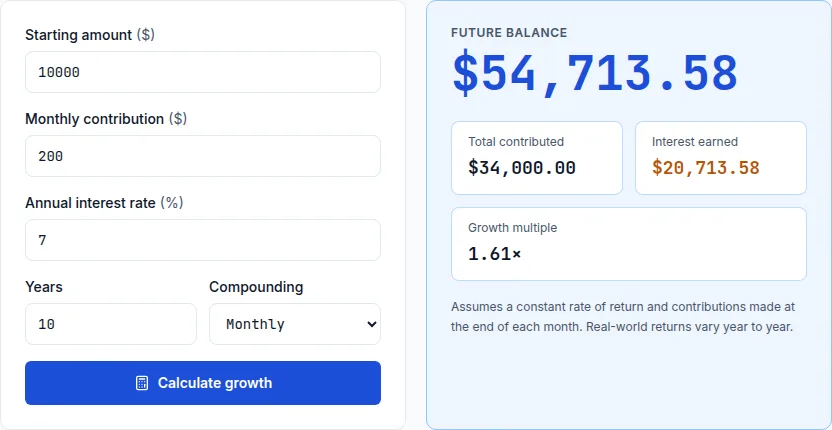
Compounding a lump sum is good; feeding the snowball monthly is better. $200 a month at 7% becomes about $34,500 after 10 years, $102,000 after 20, and $235,000 after 30 — of which only $72,000 is money you put in.
The pattern to notice: the last decade produced more growth than the first two combined. Compounding rewards whoever stays in the game longest.
Related guides
Put it into practice
The fastest way to learn the math is to play with the numbers.
Open the Compound Interest Calculator