4 min read · December 8, 2026
APY vs. Interest Rate: Why Your Savings Account Earns More Than the Advertised Rate
APY (annual percentage yield) and interest rate look like they should mean the same thing, but APY is always equal to or higher than the plain interest rate, because APY includes the effect of compounding and the interest rate alone doesn't. A 4% interest rate compounded monthly actually earns a 4.07% APY.
Why APY is always the bigger number
The interest rate is the base percentage a bank quotes — say 4% a year. But if that interest compounds monthly rather than once at year-end, the small amount of interest credited in January starts earning its own interest in February, and so on for every remaining month. That snowball effect is exactly what APY captures and the plain interest rate doesn't.
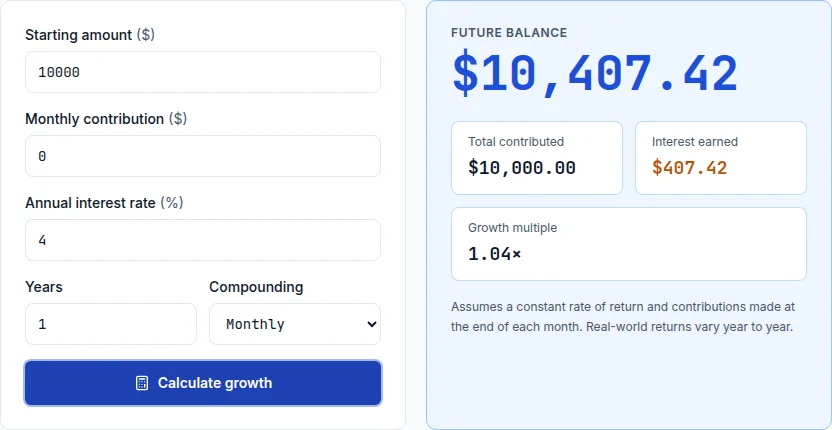
$10,000 at a 4% interest rate, compounded monthly, actually grows to $10,407.42 after a year — a 4.07% APY, not 4.00%. The gap between the stated rate and the real APY grows with more frequent compounding: daily compounding pushes it slightly higher still than monthly.
Why this matters when comparing accounts
Two banks can advertise the same 4% 'interest rate' while compounding at different frequencies, meaning they don't actually pay the same amount — the one compounding daily pays marginally more than the one compounding monthly, which pays more than the one compounding annually. This is exactly why APY, not the raw interest rate, is the number regulators require prominently displayed and the number worth comparing across accounts.
For loans, the analogous concept in the other direction is APR, which also standardizes for comparison — but APY (for money you're earning) and APR (for money you're borrowing) aren't computed identically, so don't assume they're interchangeable across a savings account and a loan.
The formula, if you want to check a bank's math
APY = (1 + r/n)^n − 1, where r is the stated annual interest rate as a decimal and n is the number of compounding periods per year. For 4% compounded monthly: (1 + 0.04/12)^12 − 1 = 0.0407, or 4.07%.
The difference between interest rate and APY shrinks as the balance and time horizon shrink, and grows for larger balances held longer — which is exactly why it's worth checking on anything you're planning to leave untouched for years, like a CD or long-term savings account, and worth ignoring as noise on a balance you're moving in and out of within weeks.
Related guides
Put it into practice
The fastest way to learn the math is to play with the numbers.
Open the Compound Interest Calculator