
4 min read · September 14, 2027
How Compound Interest Works During Retirement Withdrawals
During retirement, a balance still compounds — it's just compounding against withdrawals working in the opposite direction. If the compounding growth rate exceeds the withdrawal rate, the balance can keep growing even while money is being taken out every month; if withdrawals outpace growth, the balance shrinks, just more slowly than the withdrawals alone would suggest.
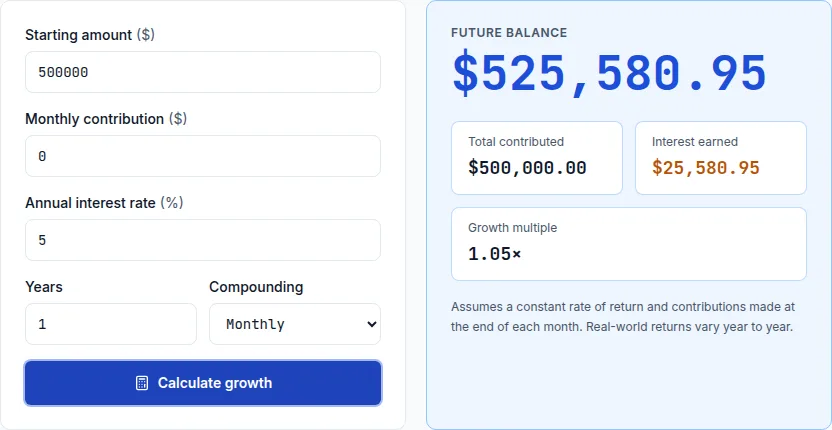
The two forces working against each other
A $500,000 balance growing at 5% compounded monthly earns $25,580.95 in its first year with no withdrawals at all — shown above. Withdraw $2,000 a month ($24,000 a year) from that same balance, and the account still grows, just by a smaller net amount: roughly $25,580.95 growth minus $24,000 withdrawn ≈ $1,580 net growth for the year, because the growth rate is still outpacing the withdrawal rate at this specific balance and withdrawal size.
This calculator models pure accumulation (growth with contributions), not withdrawals directly — but running it with zero contributions gives you the exact growth-only figure to subtract your planned withdrawals from, which is precisely the calculation shown above.
The 4% rule and why it exists
A commonly cited retirement guideline is the '4% rule': withdrawing 4% of a portfolio's starting balance annually (adjusted for inflation each year after) is historically likely to sustain a 30-year retirement without running out of money, because long-term average market returns tend to exceed a 4% withdrawal rate over most historical periods. It's a rule of thumb based on historical averages, not a guarantee — actual sequences of returns vary, and a few bad early years can matter more than the long-term average suggests.
The core mechanic behind why 4% (rather than, say, 8%) is the commonly cited figure: withdrawing faster than the portfolio's real (inflation-adjusted) growth rate steadily erodes the balance, while withdrawing slower lets compounding keep working in the retiree's favor even as money is being drawn out.
Why sequence of returns matters more than the average
A portfolio earning +10%, −5%, +10% averages the same as one earning +5%, +5%, +5% — but if withdrawals are being taken every year regardless, the volatile sequence can leave a retiree with meaningfully less money at the end, because withdrawals taken during a down year lock in losses that don't get the chance to recover, a risk purely average-return math doesn't capture. This is exactly why retirement withdrawal planning is more complex than a single compound-growth calculation and usually involves stress-testing against historically bad return sequences, not just an average expected rate.
Related guides
Put it into practice
The fastest way to learn the math is to play with the numbers.
Open the Compound Interest Calculator