3 min read · April 6, 2027
Price Per Unit: How to Tell Which Size Is Actually the Better Deal
Divide the total price by the total quantity to get the price per unit, then compare that number across sizes — not the sticker price. A 6-pack of eggs at $1.14 is 19¢ per egg; a 12-pack at $2.04 is 17¢ per egg, making the 12-pack the better deal even though its sticker price is higher.
The formula
Price per unit = total price ÷ number of units (or weight, or volume — whatever the item is measured in). Comparing that single per-unit number across package sizes tells you the real winner, regardless of how different the total prices and pack sizes look side by side.
Most grocery store shelf tags already show a per-unit price in small print — checking it takes the guesswork out entirely, but it's worth knowing the formula for anywhere that doesn't provide it (online listings, bulk retailers, non-grocery purchases).
Why bigger isn't automatically cheaper per unit
Retailers don't always price larger sizes at a lower per-unit rate — sometimes a 'family size' package carries a higher per-unit price than the standard size, banking on the assumption that shoppers assume bigger means cheaper and skip the comparison. A promotional discount on a specific size can also flip which size wins even if the undiscounted per-unit prices favored the other.
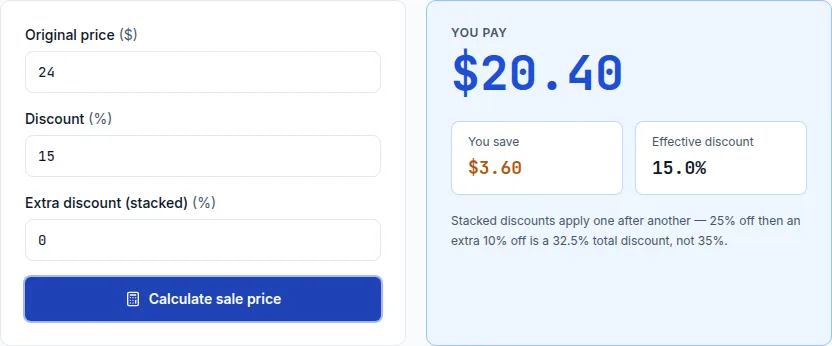
A $24 case of 12 items discounted 15% comes to $20.40 — $1.70 per item. If the same product's smaller size sells at $1.60 per item undiscounted, the 'discounted bulk deal' is actually the worse per-unit price despite the sale badge, which is exactly the kind of comparison the sticker price alone hides.
When the smaller size still makes sense anyway
A lower price per unit isn't automatically the right choice — perishables you won't finish before spoiling, limited storage space, and cash-flow constraints on a large upfront purchase are all legitimate reasons to buy the smaller, more expensive-per-unit size.
The unit price comparison answers 'which is cheaper per unit,' not 'which should I buy' — the second question depends on how much of it you'll actually use before it goes to waste.
Related guides
Put it into practice
The fastest way to learn the math is to play with the numbers.
Open the Discount Calculator