4 min read · January 12, 2027
Buy One Get One (BOGO) vs. a Flat Percentage Off: Which Actually Saves More?
A straight 'buy one get one free' (BOGO) offer is mathematically identical to 50% off both items combined — buy two $50 items for $50 total is the same as paying $50 for $100 worth of product, a 50% discount either way. The catch is BOGO forces you to buy two items to get that rate; a flat 50% off applies even to a single item.
Why BOGO-free equals 50% off — but only on the pair
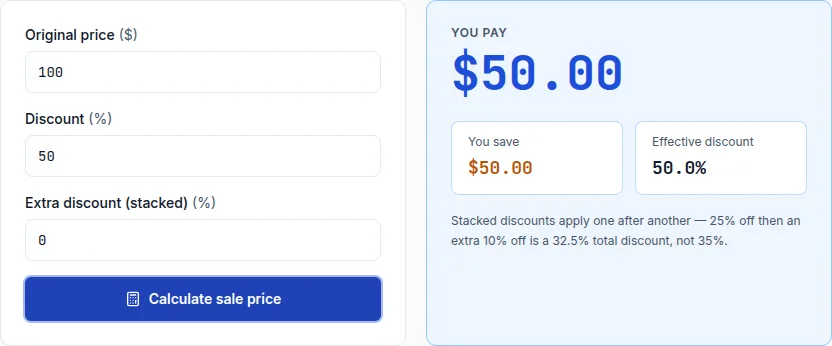
Two $50 items normally cost $100. Under 'buy one get one free,' you pay $50 for both — exactly the $50 result you'd get by entering the combined $100 price into a discount calculator at 50% off. The offer isn't secretly a worse deal than it sounds; the math genuinely checks out as an even 50% discount, applied across the pair.
The real catch is the forced quantity. If you only wanted one item, BOGO-free saves you nothing — you'd pay full price for the single item, since there's no second item to get free. A flat 50%-off sale, by contrast, saves you money on a single item too. For one item, flat percentage off is strictly the better deal even when the headline BOGO number looks bigger.
'Buy one, get one 50% off' is a smaller discount than it sounds
This common variant only discounts the second item, and only by half — not both items. Two $50 items: pay $50 for the first, $25 for the second (50% off), for $75 total on $100 worth of product — a 25% effective discount across the pair, not 50%.
That's exactly half the savings rate of the full BOGO-free version, which is easy to miss since both offers use the same 'buy one get one' phrasing and only differ by the word 'free' versus '50% off.'
When a flat percentage beats BOGO outright
If you only need one of the item, any BOGO offer (free or discounted) is worthless to you — a flat percentage off wins by definition since it doesn't require a second purchase. If you need exactly two, full BOGO-free (effectively 50% off the pair) beats a flat discount under 50%, and loses to a flat discount of 50% or more.
The general rule: compute the effective discount rate each offer gives on the quantity you actually intend to buy, then compare that single number — the marketing framing (BOGO vs. percentage) doesn't matter once you've done that.
Related guides
Put it into practice
The fastest way to learn the math is to play with the numbers.
Open the Discount Calculator