
4 min read · November 17, 2026
Discount Then Tax, or Tax Then Discount? The Order That Actually Saves You Money
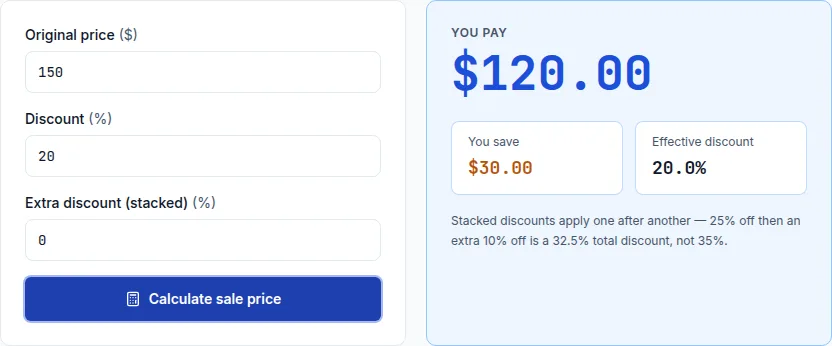
In the vast majority of U.S. jurisdictions, tax is calculated on the discounted price, not the original price — discount first, then tax. A $150 item with 20% off and 8% sales tax comes to $150 × 0.80 = $120, then $120 × 1.08 = $129.60, not $150 × 1.08 first.
Why discount comes first
Sales tax is a tax on what you actually paid, not on the sticker price — so it's calculated on the sale price after any discount has already been subtracted. Once you've got the discounted price, tax is simply that number multiplied by (1 + tax rate).
Applying tax to the original price first, then discounting the tax-inclusive total, isn't just the wrong order procedurally — for a percentage discount it happens to land on the same final number as discounting first (multiplication is commutative), so this particular error is harmless for a straight percentage discount. It matters much more for flat dollar-amount discounts and coupons, covered below.
Worked example
$150 item, 20% off, 8% sales tax. Step 1: apply the discount — $150 × 0.80 = $120. Step 2: apply tax to that discounted price — $120 × 1.08 = $129.60. That $129.60 is the real total.
For comparison, taxing the full $150 first ($150 × 1.08 = $162) and then discounting that by 20% also gives $129.60 — confirming that for a pure percentage discount, order genuinely doesn't change the answer. The practical reason retailers and receipts still show 'discount then tax' as the standard sequence is clarity and consistency across discount types, not because the math forces it for percentages specifically.
Where order actually does matter: flat-dollar coupons
A flat $20-off coupon is not the same math as a percentage discount, and here order genuinely changes the result. $150 item, $20 off, 8% tax: discount first gives $130 × 1.08 = $140.40. Taxing the full $150 first ($162), then subtracting a flat $20, gives $142 — a real $1.60 difference, because a flat dollar discount doesn't scale the same way a percentage does.
This is why receipts for coupon-based purchases specifically show the discount line applied before the tax line: for flat-amount discounts, that ordering is not just conventional, it's the only version that correctly taxes only what you actually paid.
Related guides
Put it into practice
The fastest way to learn the math is to play with the numbers.
Open the Discount Calculator