6 min read · June 2, 2026
How to Calculate Loan Payments (Step by Step)
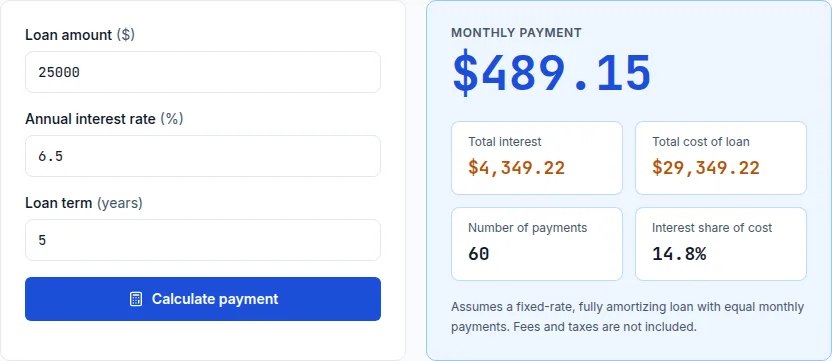
To calculate a loan payment with interest: M = P × [r(1+r)^n] / [(1+r)^n − 1], where P is the amount borrowed, r is the monthly interest rate (annual rate ÷ 12), and n is the number of monthly payments (years × 12). A $25,000 loan at 6.5% for 5 years comes to $489.15 a month.
How to calculate a loan payment with interest
The monthly payment on a fixed-rate loan is M = P × [r(1+r)^n] / [(1+r)^n − 1], where P is the amount borrowed, r is the monthly interest rate (the annual rate divided by 12), and n is the number of monthly payments (years × 12).
The formula answers one question: what single payment amount, repeated n times, pays off both the principal and all the interest that accrues along the way, landing at exactly zero on the final payment?
A worked example
Say you borrow $25,000 at 6.5% for 5 years. The monthly rate is 0.065 / 12 = 0.005417, and n is 60 payments. Plugging in: M = 25,000 × [0.005417 × 1.005417^60] / [1.005417^60 − 1] = $489.15 per month.
Over 60 payments you'll hand over $29,349 in total — meaning the loan cost you $4,349 in interest on top of the $25,000 you borrowed. That interest figure is the number to watch when comparing loan offers.
Why early payments are mostly interest
Each month, interest is charged on the remaining balance. At the start the balance is highest, so more of your fixed payment goes to interest. On the $25,000 loan above, the first payment includes about $135 of interest; by the final year it's under $30.
This is why extra payments early in a loan are so powerful: every extra dollar goes straight to principal, permanently reducing the balance that all future interest is calculated on.
Three ways to pay less interest
First, shorten the term: moving from a 6-year to a 4-year car loan raises the monthly payment but can cut total interest by a third or more. Second, shop the rate — a single percentage point on a mortgage is tens of thousands of dollars over 30 years. Third, pay extra principal when you can, and confirm your lender applies it to principal rather than future payments.
Related guides
Put it into practice
The fastest way to learn the math is to play with the numbers.
Open the Loan Calculator