
4 min read · March 2, 2027
How Extra Payments Reduce Total Loan Interest
Every extra dollar paid toward a loan's principal stops accruing interest immediately, which is why even modest extra payments can save thousands in total interest and cut years off a loan — an extra $50 a month on a typical mortgage can save over $20,000 in interest and pay it off more than two years early.
Why extra payments punch above their weight
Interest each month is charged on the remaining balance — so a payment that goes straight to principal shrinks every future month's interest charge, not just that one payment's. Mortgage interest is also front-loaded (early payments are mostly interest), which is exactly why extra payments made early in a loan save far more than the same extra payments made near the end.
This compounding-in-reverse effect is why a relatively small consistent extra payment can outperform what intuition suggests — the savings aren't linear with the extra amount, they accelerate the earlier in the loan they start.
Estimating the savings with a standard loan calculator
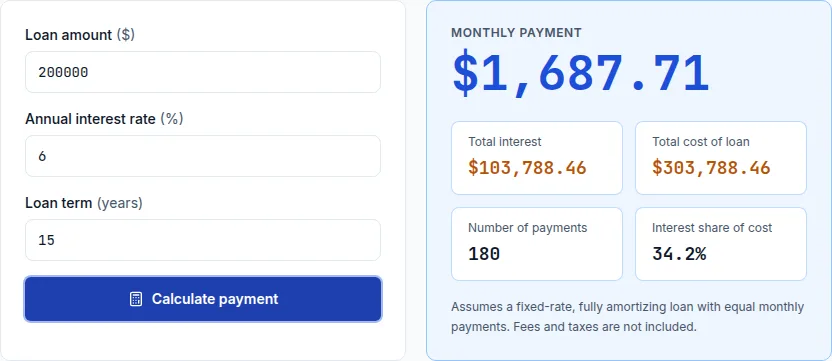
Most simple loan calculators — including this one — don't have a dedicated 'extra payment' field, but you can estimate the effect by comparing two runs: the original term at the original rate, and a shorter term at the same rate. A $200,000 loan at 6% run at a 15-year term instead of 30 shows both the higher monthly payment and the dramatically lower total interest that faster payoff produces — which approximates what sustained extra payments accomplish, since both approaches shrink the balance faster than the minimum schedule requires.
For a precise, payment-by-payment answer (exactly how many months an extra $X per month saves, starting in a specific year), a dedicated amortization calculator that accepts an extra-payment input is the more precise tool — the term-comparison technique above is a fast estimate, not a substitute for one.
Where to check before making extra payments
Confirm with your lender that extra payments are applied to principal by default, not held as a credit toward next month's payment — some servicers require you to explicitly designate an extra payment as 'principal only,' and skipping that step can silently defeat the whole strategy.
Also confirm there's no prepayment penalty, which some loans (less common today, but not extinct) charge for paying off early — rare, but worth the one-time check before committing to a consistent extra-payment plan.
Related guides
Put it into practice
The fastest way to learn the math is to play with the numbers.
Open the Loan Calculator