6 min read · September 1, 2026
15-Year vs. 30-Year Mortgage: What the Math Actually Says
The 15-year vs. 30-year mortgage decision comes down to one trade-off: a noticeably higher monthly payment in exchange for a dramatically lower total interest cost. Seeing the actual numbers side by side makes the decision much clearer than the rules of thumb usually offered.
The monthly payment gap is smaller than the loan-term ratio suggests
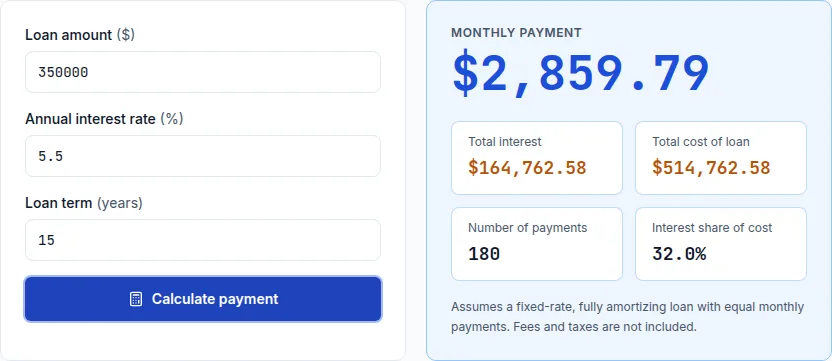
On a $350,000 mortgage at a typical rate spread (15-year loans usually carry a lower rate than 30-year), the 15-year payment often runs 45–55% higher than the 30-year payment — not double, even though the term is half as long, because 15-year loans typically come with a meaningfully lower interest rate that partially offsets the shorter payoff window.
That said, the higher payment is still a real, binding monthly commitment. Lenders' debt-to-income requirements are often stricter for 15-year terms specifically because the payment consumes a larger share of monthly income.
The total interest difference is dramatic
This is where the comparison becomes lopsided. On that same $350,000 loan, a 30-year term at a higher rate can rack up two to three times more total interest over its life than the 15-year version — often the difference between roughly $150,000 and $400,000+ in total interest paid, depending on the exact rates.
The reason is compounding: a 30-year loan carries a balance (and therefore accrues interest) for twice as long, and typically at a higher rate too — both factors point the same direction.
So which is 'better'?
There's no universally correct answer — it depends on cash flow flexibility and opportunity cost. A 30-year loan frees up monthly cash that could be invested elsewhere (historically, stock market returns have often outpaced mortgage interest rates, though that's not guaranteed), while a 15-year loan guarantees interest savings with certainty and builds equity faster.
A popular middle ground: take the 30-year loan for payment flexibility, but voluntarily make extra principal payments sized like a 15-year schedule when cash flow allows — this keeps the lower required minimum payment as a safety net while still capturing most of the interest savings.
Put it into practice
The fastest way to learn the math is to play with the numbers.
Open the Loan Calculator