4 min read · October 6, 2026
Reverse Percentages: How to Find the Original Price Before a Discount or Increase
To find the original amount before a percentage change, divide the final value by (1 + the percentage as a decimal) for an increase, or by (1 − the percentage as a decimal) for a decrease. A price that rose 10% to $220 started at $220 ÷ 1.10 = $200 — not $220 minus 10%, which is the mistake almost everyone makes on their first try.
Why you can't just subtract the percentage back off
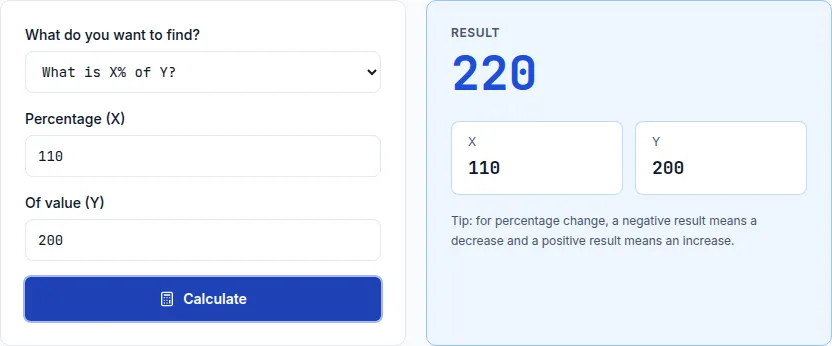
The instinctive move — take a price that increased by 10% and subtract 10% off it — gives the wrong answer, and the gap grows with bigger percentages. $220 minus 10% is $198, not the $200 it actually started at. The error happens because 10% of $220 isn't the same amount as 10% of the original $200; the percentage was calculated on a smaller base than the one you're subtracting it from.
The fix is to think in terms of what the final value represents as a percentage of the original, not the other way around. A 10% increase means the final value is 110% of the original — so dividing by 1.10 undoes it exactly, while subtracting 10% never can.
The reverse percentage formula
For an increase: original = final value ÷ (1 + percentage/100). For a decrease: original = final value ÷ (1 − percentage/100). A jacket on sale for $75 after a 25% discount started at $75 ÷ 0.75 = $100. A salary that grew 8% to $70,200 started at $70,200 ÷ 1.08 = $65,000.
The same formula is what removing VAT or sales tax from a tax-inclusive price actually is — it's a reverse percentage problem wearing a different name. A UK price of £120 including 20% VAT has a pre-tax value of £120 ÷ 1.20 = £100, not £120 minus 20% (£96).
A worked example both directions
Forward (the easy direction): a $200 item with a 10% increase becomes $200 × 1.10 = $220. Reverse (the direction people actually get stuck on): given the $220 final price and the 10% increase, find the $200 original by dividing — $220 ÷ 1.10 = $200.
Once you have a candidate original value, it's worth checking it the easy way: does the original plus the stated percentage actually land back on the final number? $200 × 1.10 = $220 confirms the reverse calculation was done correctly.
Related guides
Put it into practice
The fastest way to learn the math is to play with the numbers.
Open the Percentage Calculator