
3 min read · April 20, 2027
How to Calculate a Salary Raise Percentage
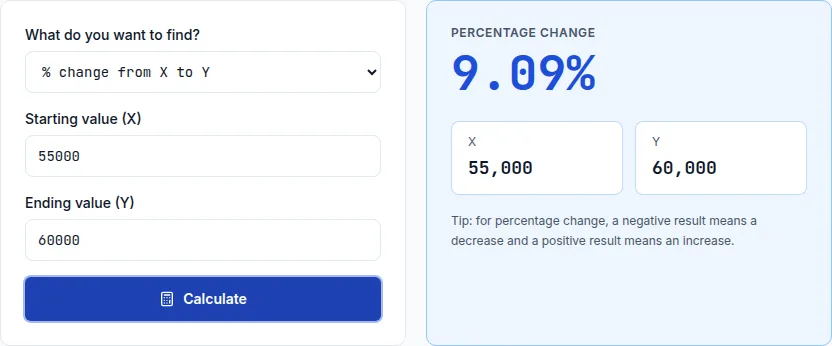
To find a raise percentage, subtract your old salary from your new one, divide by the old salary, then multiply by 100. A raise from $55,000 to $60,000 is ($60,000 − $55,000) ÷ $55,000 × 100 = 9.09%.
The formula
Raise % = (new salary − old salary) ÷ old salary × 100. This is the same percentage-change formula used everywhere else percentages compare a before-and-after value — a raise is just a percentage increase applied to your pay specifically.
The base for the calculation is always the old salary, not the new one — a common mix-up. $5,000 is a 9.09% raise on a $55,000 salary, but that same $5,000 would only be an 8.33% raise if calculated (incorrectly) against the new $60,000 figure.
What counts as a good raise
A standard annual cost-of-living raise typically runs 2–4%, roughly tracking inflation. A merit raise for solid performance is commonly 3–5%. A promotion or a raise tied to taking on significantly more responsibility often lands in the 10–20% range, and a raise from switching employers entirely frequently exceeds that — job switchers have historically out-earned people who stay, specifically because internal raises are capped more conservatively than what a new employer will offer to win a candidate.
Context matters more than the percentage alone: a 3% raise in a year of 6% inflation is a real pay cut in purchasing power even though the number on paper went up.
Turning a target dollar amount into the ask
Working backward is just as useful heading into a negotiation: decide the dollar amount you want, divide by your current salary, and you have the percentage to ask for. Wanting an extra $4,000 on a $52,000 salary is an 7.7% ask — framing the conversation in the number that matters (percentage relative to your current pay) rather than just the raw dollar figure.
Related guides
Put it into practice
The fastest way to learn the math is to play with the numbers.
Open the Percentage Calculator