
5 min read · July 14, 2026
Percentage Change Explained: Why 50% Off Then 50% Off Isn't 100% Off
Percentages feel simple until two of them get combined — a 50% pay cut followed by a 50% raise doesn't get you back to where you started, and that surprises almost everyone the first time they do the math. The reason is a small, consistent rule that's worth actually understanding rather than memorizing.
The rule: the base keeps changing
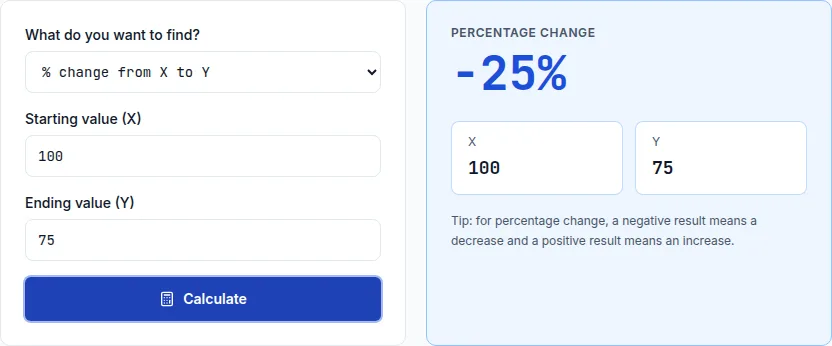
Every percentage change is measured against a specific starting number — the base. The formula is ((new − old) / old) × 100. The catch is that once a change happens, the 'old' value for the NEXT change is the new, already-changed number, not the original one.
Take $100: a 50% cut brings it to $50. A 50% increase on that new $50 is only $25, bringing the total to $75 — not back to $100. The percentages were equal, but they applied to different bases.
Why this matters for real prices
Retailers use this asymmetry constantly. A jacket marked up 50% from $100 to $150, then put on a '50% off' sale, drops to $75 — a real discount, but not a return to the original $100, and definitely not free. Reading '50% off' as 'half price' only works relative to the price it's applied to, not some earlier price you remember.
The same logic explains why a stock that drops 50% needs to gain 100%, not 50%, to get back to even — the loss shrank the base it has to grow from.
A quick way to check your intuition
When percentages compound (one applied after another), multiply the decimal factors instead of adding the percentages. Two 50% cuts are 0.5 × 0.5 = 0.25, meaning 75% off total, not 100% off. A 20% increase followed by a 20% decrease is 1.2 × 0.8 = 0.96 — a net 4% decrease, not zero.
This 'multiply the factors' trick is the fastest way to sanity-check any multi-step percentage problem without falling into the addition trap.
Put it into practice
The fastest way to learn the math is to play with the numbers.
Open the Percentage Calculator