4 min read · January 5, 2027
Markup vs. Margin: Why a 50% Markup Isn't a 50% Margin
Markup is profit divided by cost; margin is profit divided by selling price — and because selling price is always higher than cost on a profitable sale, margin is always a smaller percentage than markup on the exact same dollar amount of profit. A $30 profit on a $70 cost item is a 42.9% markup but only a 30% margin.
The two formulas side by side
Markup % = profit ÷ cost × 100. Margin % = profit ÷ selling price × 100. Same numerator (the dollar profit), different denominator — and that denominator choice is the entire source of the confusion. Buy something for $70, sell it for $100: profit is $30 either way, markup is $30 ÷ $70 = 42.9%, margin is $30 ÷ $100 = 30%.
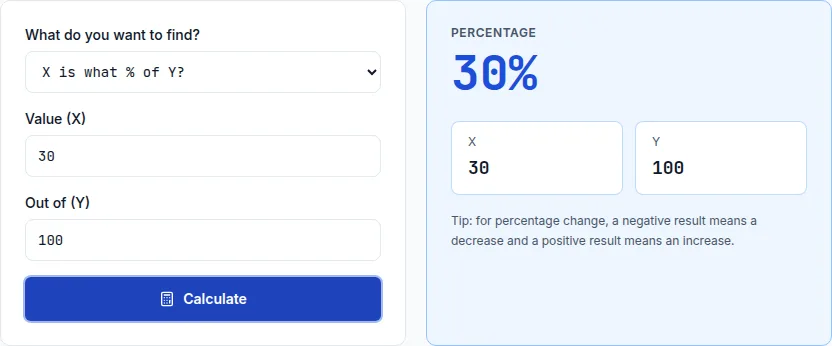
This calculator's 'X is what % of Y' mode computes margin directly when X is the profit and Y is the selling price — entering $30 and $100 gives 30%, exactly the margin figure. Swap Y to the cost ($70) instead and the same mode gives you the markup figure (42.9%) with no other change needed.
Why the mix-up costs real money
A business owner who wants a 40% margin but mistakenly sets a 40% markup ends up with a real margin of only about 28.6% ($40 profit on a $140 selling price for a $100 cost item is $40 ÷ $140 = 28.6%) — a meaningful, compounding shortfall across every sale if the pricing was built on the wrong formula from the start.
This is a common and expensive small-business pricing mistake precisely because '40% markup' and '40% margin' sound interchangeable in casual conversation but are never the same number for the same sale.
Converting between them
Margin from markup: margin = markup ÷ (1 + markup). A 50% markup converts to 50% ÷ 1.5 = 33.3% margin. Markup from margin: markup = margin ÷ (1 − margin). A 30% margin converts to 30% ÷ 0.7 = 42.9% markup — matching the worked example above.
When setting prices, deciding which one to target first matters: retailers thinking in terms of 'what percentage of revenue is profit' should set a margin target and back into the markup; those thinking in terms of 'how much do I add on top of cost' should do the reverse — but either way, knowing which formula you're actually using prevents the pricing gap above.
Related guides
Put it into practice
The fastest way to learn the math is to play with the numbers.
Open the Percentage Calculator