3 min read · August 31, 2027
Percentage of a Percentage: How Compounding Percentages Work
A percentage of a percentage is found by multiplying the two decimal forms together, not adding the percentages. 20% of 50% is 0.20 × 0.50 = 0.10, or 10% — not 70%, which is the instinctive (and wrong) answer most people reach for first.
Why you multiply instead of add
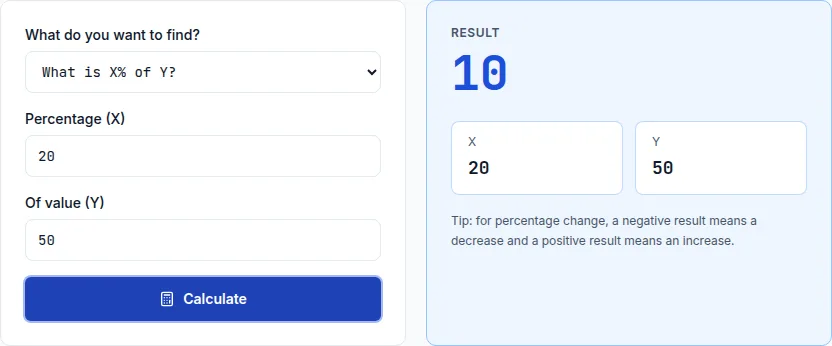
Convert both percentages to decimals and multiply: 20% of 50% = 0.20 × 0.50 = 0.10 = 10%. This calculator's ordinary 'X% of Y' mode does exactly this — enter 20 for X and 50 for Y (treating 50 as the number 50, which represents 50%), and it returns 10, matching the percentage-of-a-percentage answer directly.
Adding percentages together (20% + 50% = 70%) answers a completely different question — it's only correct when you're combining two separate percentages of the same base, not when one percentage is being applied to another percentage.
Where this actually comes up
Compounding discounts: '25% off, plus an extra 10% off' is 10% of the already-discounted 75%, not a flat 35% off. Tax-on-a-fee calculations: a 3% processing fee on an amount that already includes 8% sales tax requires multiplying the two rates' effects together, not summing them. Commission on commission, interest on a fee, or any scenario where one percentage rate is applied on top of another all follow this same multiply-don't-add rule.
The stacked-discount example is the most common real-world version: 25% off then an extra 10% off works out to a 32.5% total discount (multiply 0.75 × 0.90 = 0.675, so you pay 67.5% — a 32.5% discount), not the 35% naive addition would suggest.
The quick mental check
If the answer to 'X% of Y%' ever comes out larger than both X and Y individually, something's wrong — multiplying two percentages (each under 100%) always produces a result smaller than either one alone, since you're taking a fraction of a fraction. That's a fast sanity check that catches the 'I added instead of multiplied' mistake before it costs real money.
Related guides
Put it into practice
The fastest way to learn the math is to play with the numbers.
Open the Percentage Calculator