
5 min read · February 23, 2027
How to Calculate Weighted GPA (AP, IB, and Honors Bonus Points)
Weighted GPA adds bonus points on top of the standard 4.0 scale for harder courses — commonly +1.0 for AP or IB classes and +0.5 for Honors classes — so an A in an AP class can count as a 5.0 instead of a 4.0. The exact bonus varies by school, which is the single biggest source of confusion around this number.
The common weighting scale
The most widespread system: regular classes use the standard scale (A=4.0, B=3.0, etc.), Honors classes add +0.5 to each grade point, and AP or IB classes add +1.0. An A in a regular class is 4.0; an A in an Honors class is 4.5; an A in an AP or IB class is 5.0.
Some schools use different increments — +0.5 for AP and +0.3 for Honors is a common alternative — so this scale is representative, not universal. Checking your own school's specific policy before reporting a weighted GPA anywhere official is worth the extra step.
Worked example, step by step
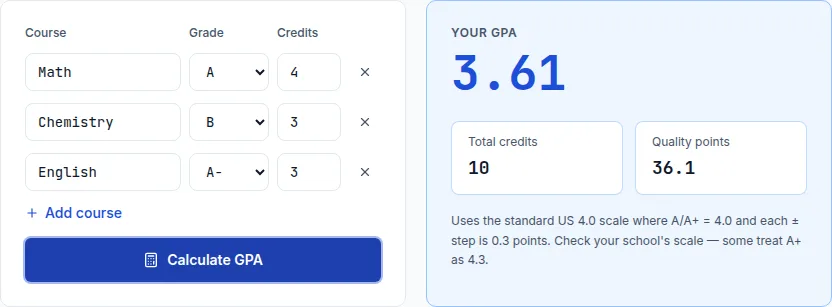
Take an unweighted GPA calculator's output as the starting point — three courses graded A (4cr), B (3cr), and A- (3cr) give an unweighted GPA of 3.61 (37.0 quality points ÷ 10.25... using this calculator's method, 4×4 + 3×3 + 3.7×3 = 16 + 9 + 11.1 = 36.1 quality points over 10 credits = 3.61).
Now apply weighting: if the 4-credit 'Math' course was AP, add 1.0 to its grade point before multiplying — (4.0+1.0)×4 = 20 quality points instead of 16. Recompute the total: 20 + 9 + 11.1 = 40.1 over the same 10 credits = 4.01 weighted GPA. The unweighted calculator gives the base number; the weighting bonus is added by hand per course before re-averaging.
Why colleges often ignore the weighting anyway
Most colleges recalculate every applicant's GPA on their own standardized scale during admissions review — frequently stripping weighting bonuses back out entirely so they're comparing every applicant on the same unweighted footing, regardless of how generous or conservative each high school's weighting policy was.
This means a weighted GPA is genuinely useful for class rank and for understanding how your own school ranks your effort in harder courses, but it isn't necessarily the number that drives an admissions decision — the unweighted GPA (or the college's own recalculation) often matters more than the weighted headline number suggests.
Related guides
Put it into practice
The fastest way to learn the math is to play with the numbers.
Open the GPA Calculator