
6 min read · August 18, 2026
How GPA Is Calculated (And How to Raise It Strategically)
GPA looks like a single simple average, but the credit-hour weighting behind it means not all classes affect your GPA equally — understanding the mechanics changes how you'd actually go about raising one.
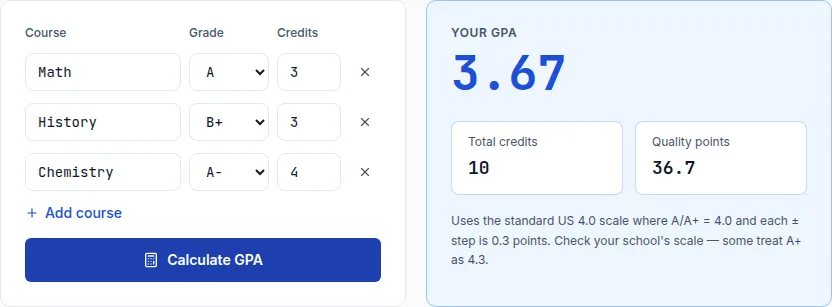
The grade points behind the letters
Each letter grade converts to a point value on the standard 4.0 scale: A/A+ = 4.0, A− = 3.7, B+ = 3.3, B = 3.0, and so on down to F = 0, stepping by 0.3 for each plus or minus. These point values, not the letters themselves, are what actually get averaged.
Some schools award 4.3 for an A+ rather than capping at 4.0 — always check your institution's specific scale before comparing your GPA to a published benchmark.
Why credit hours change everything
GPA is a credit-weighted average, not a simple average of grades. A 4-credit course with a B (3.0 × 4 = 12 quality points) affects your GPA twice as much as a 2-credit course with the same B (3.0 × 2 = 6 quality points). This means a poor grade in a heavy course does more damage — and a strong grade in one does more good — than the same letter grade in a lighter course.
This is exactly why strategic students sometimes prioritize their effort on higher-credit courses when triaging a busy semester: the GPA impact per hour of study is larger there.
The math of actually raising a GPA
Because GPA is an average over ALL credits taken so far, a single strong semester moves the needle less as your total credit count grows. Someone with 90 credits and a 2.8 GPA needs a much stronger following semester to reach 3.0 than someone with 20 credits at the same GPA — there's simply more historical weight to offset.
A rough estimate: to raise a GPA by X points, you generally need roughly (X × existing credits) in extra quality points from new courses — which is why GPA repair is a gradual, multi-semester project rather than a single strong term fixing everything.
Weighted vs. unweighted GPA
High schools often report a weighted GPA that adds bonus points for AP/honors courses (sometimes up to 5.0 for an A in AP), while colleges almost universally use unweighted GPA capped at 4.0. If you're comparing GPAs across contexts — for a scholarship or transfer application — confirm which scale each number uses before drawing conclusions.
Put it into practice
The fastest way to learn the math is to play with the numbers.
Open the GPA Calculator