5 min read · June 16, 2026
Salary to Hourly: What Your Annual Pay Really Means
A $65,000 salary sounds concrete until someone asks what you make an hour. Converting between the two is simple arithmetic, but the assumptions you choose — real hours worked, unpaid time off — change the answer more than most people expect.
The standard conversion
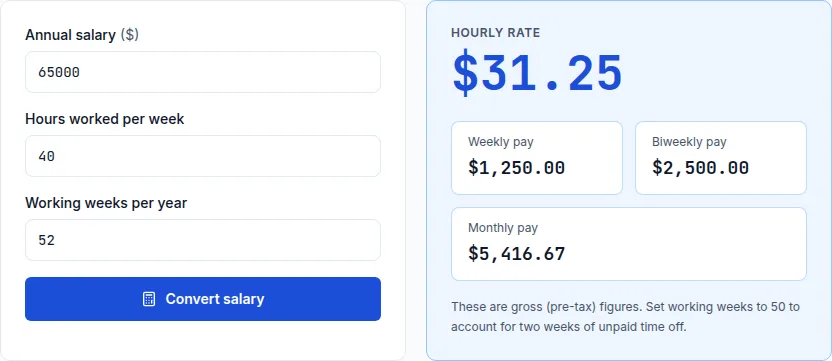
Divide the annual salary by hours worked per year. The standard assumption is 40 hours × 52 weeks = 2,080 hours, so $65,000 a year is $65,000 / 2,080 = $31.25 an hour.
Handy benchmarks at 2,080 hours: $40,000 ≈ $19.23/hr, $50,000 ≈ $24.04/hr, $75,000 ≈ $36.06/hr, $100,000 ≈ $48.08/hr. A quick mental shortcut: annual salary divided by 2,000 — just drop three zeros and halve it.
Your real hourly rate
The standard math assumes you work exactly 40 hours. If your salaried job routinely demands 50-hour weeks, your true rate on that $65,000 is $25 an hour, not $31.25 — a 20% pay cut nobody announced.
Freelancers should flip the adjustment: without paid vacation, sick days, or holidays, you might bill only 46–48 weeks a year, and no one pays for your admin time. A common rule of thumb is that a freelance hourly rate needs to be 50–100% above the equivalent employee rate to break even after benefits, self-employment taxes, and unbillable hours.
Comparing a salary offer to an hourly job
Hourly roles are usually eligible for overtime pay at 1.5×, while most salaried roles are exempt — so an hourly job at the 'same' rate can out-earn the salary when overtime is common. On the other hand, salaried positions more often carry benefits: employer health premiums, retirement matching, and paid leave routinely add 20–30% on top of the stated salary.
The fair comparison is total compensation per hour actually worked. Compute it for both offers before deciding — the winner is often not the bigger headline number.
Related guides
Put it into practice
The fastest way to learn the math is to play with the numbers.
Open the Salary to Hourly Calculator