
4 min read · December 22, 2026
How to Calculate Overtime Pay (Time-and-a-Half, Explained)
Overtime pay in the US is calculated at 1.5× your regular hourly rate for hours worked beyond 40 in a week — a $25/hour base rate becomes $37.50/hour for every overtime hour. The step people usually get stuck on isn't the 1.5×, it's finding the correct base hourly rate to multiply in the first place.
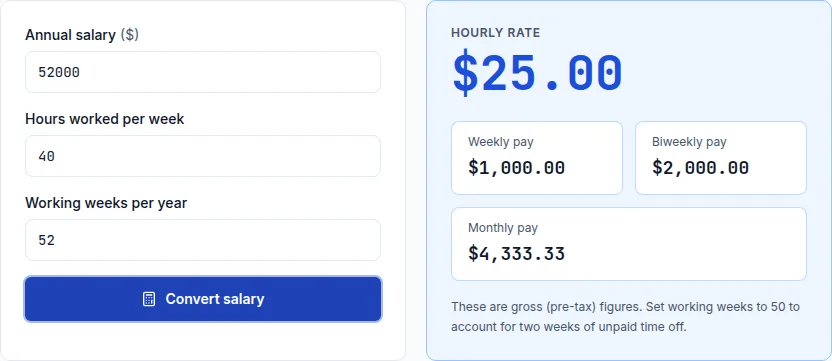
Finding your base rate first
If you're paid hourly, your base rate is simply your stated hourly wage. If you're salaried but nonexempt (meaning you're still legally entitled to overtime), convert the annual salary to an hourly rate the standard way — divide by 2,080 (40 hours × 52 weeks). A $52,000 salary works out to a $25.00 base hourly rate.
That $25.00 is what gets multiplied by 1.5, not the salary itself — a mistake worth double-checking on a first calculation, since it's easy to accidentally apply the multiplier to the wrong number.
The time-and-a-half calculation
Overtime rate = base hourly rate × 1.5. At a $25.00 base rate, that's $37.50 per overtime hour. Work 46 hours in a week: the first 40 are paid at $25.00 ($1,000), and the remaining 6 are paid at $37.50 ($225), for a total of $1,225 — not $1,150, which is what a flat $25/hour for all 46 hours would incorrectly give.
Some states and some employers use 'double time' (2×) for hours beyond a higher threshold or for specific circumstances like working a seventh consecutive day — check state-specific rules, since federal law sets the 1.5× floor but doesn't cap what a state can require above it.
Who's actually entitled to overtime
Under US federal law, hourly (nonexempt) employees are entitled to overtime; salaried employees classified as 'exempt' generally are not, regardless of how many hours they actually work. Exempt status depends on both a minimum salary threshold and the type of work performed — job title alone doesn't determine it, and misclassification is a common wage dispute.
If your exact status is unclear, that's worth confirming directly rather than assuming from your pay structure — being salaried does not automatically mean you're ineligible for overtime.
Related guides
Put it into practice
The fastest way to learn the math is to play with the numbers.
Open the Salary to Hourly Calculator