
3 min read · March 23, 2027
How Many Work Hours Are in a Year? (2,080 and the Real-World Adjustments)
The standard baseline is 2,080 work hours a year — 40 hours a week × 52 weeks. It's the number every salary-to-hourly conversion assumes by default, but it doesn't account for holidays, vacation, or the fact that some calendar years have slightly more or fewer working days than others.
Where 2,080 comes from
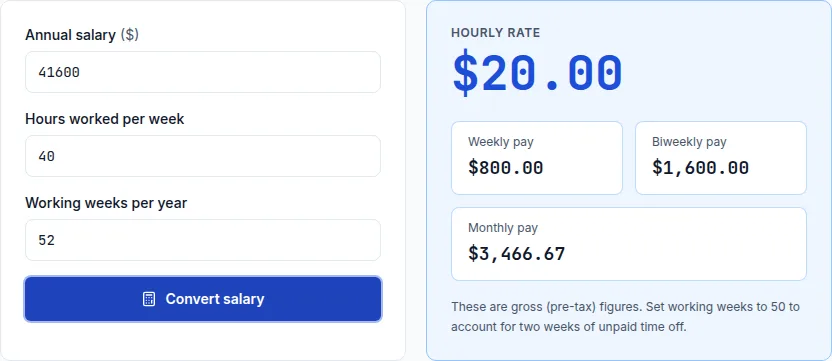
52 weeks in a year × 40 hours a week = 2,080 hours. It's the figure used for virtually every standard salary-to-hourly conversion, and it's why dividing an annual salary by 2,080 (or the shortcut of dividing by 2,000 and adjusting slightly) gives the widely quoted hourly-equivalent rate. A $41,600 salary divided by 2,080 hours is an exact, clean $20.00 an hour.
This baseline assumes every week is a full 40-hour working week with no time off — which is why it's a useful reference number, not a description of how many hours anyone actually works in practice.
Your real number after time off
A full-time employee with two weeks of vacation and 10 paid holidays actually works closer to 1,880–1,920 hours a year, not 2,080 — the difference matters for anyone trying to calculate a true effective hourly rate rather than the theoretical baseline. Subtracting your actual paid time off from 2,080 gives a more honest number to divide your salary by.
Part-time schedules obviously scale down proportionally — someone working 25 hours a week for 52 weeks logs 1,300 hours a year, a little over 60% of the full-time baseline.
Why the exact number shifts slightly by calendar year
Because a year has 365 or 366 days and weeks don't divide evenly into that, the actual number of weekdays (and therefore theoretical maximum working hours) varies slightly year to year — some years land on 260 weekdays, others 261 or 262, depending on how the calendar falls. The difference is only a few hours either way and is normally immaterial next to the much larger effect of actual holidays and vacation taken.
For any calculation that matters — comparing a job offer, negotiating a rate — using your specific actual working weeks (52 minus your real paid time off) rather than the flat 2,080 baseline gives a meaningfully more accurate number.
Related guides
Put it into practice
The fastest way to learn the math is to play with the numbers.
Open the Salary to Hourly Calculator