
4 min read · April 27, 2027
How to Calculate Your Pregnancy Due Date
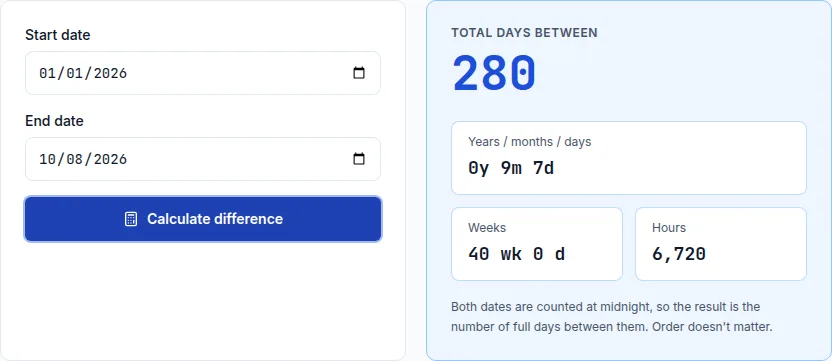
The standard due date estimate is 280 days (40 weeks) after the first day of your last menstrual period (LMP) — not the conception date. A period starting January 1 gives an estimated due date around October 8.
Why the LMP method counts from before conception
Pregnancy is conventionally dated from the first day of the last menstrual period, not from conception — which happens roughly two weeks later, around ovulation. That's why 'week 4 of pregnancy' can sound confusing: your period and the two weeks before ovulation are counted as the first two weeks, even though you weren't actually pregnant yet during them.
This convention exists because the LMP date is something most people can identify with reasonable confidence, while the exact conception date usually isn't known precisely — even for people tracking ovulation, fertilization can happen anywhere in a several-day fertile window.
The calculation
Add 280 days (40 weeks) to the first day of your last period, or equivalently: add 9 months and 7 days to that date (a common shortcut called Naegele's rule). Both methods land on the same estimated due date.
This assumes a textbook 28-day cycle with ovulation on day 14 — if your cycle is meaningfully longer or shorter than 28 days, the true due date shifts accordingly, which is one reason this estimate and your provider's ultrasound-based estimate can differ by several days to a week or more.
Why your due date might change after an ultrasound
An early ultrasound measures the fetus directly and is considered more accurate than the LMP method alone, especially for anyone with irregular cycles, uncertain LMP dates, or conception via fertility treatment (where the transfer or conception date is known precisely). If your provider's ultrasound-based due date differs from the LMP calculation, the ultrasound date is generally the one used going forward.
Either way, a due date is an estimate, not a deadline — full-term birth is defined as anywhere from 3 weeks before to 2 weeks after the calculated date, a normal range of about five weeks wide.
Related guides
Put it into practice
The fastest way to learn the math is to play with the numbers.
Open the Date Difference Calculator