4 min read · September 22, 2026
Counting Down to a Future Date: The Math Behind 'X Days Until'
A wedding, a trip, a deadline, a due date — 'how many days until' is one of the most common date questions people ask, and it's also one people get subtly wrong more often than they'd expect, usually by forgetting which direction is being counted.
It's the same subtraction, just pointed forward
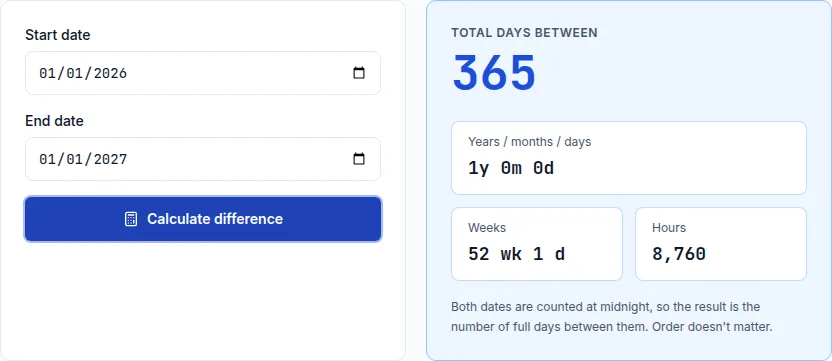
A countdown is really just a date difference where one of the two dates happens to be today. Convert both dates to a single continuous day count and subtract: target date minus today equals days remaining. There's no separate 'countdown formula' — it's the same calendar math used for any date difference, just always anchored to the present.
The one thing worth double-checking is direction: 'days until' should always come back positive for a future date. If a countdown produces a negative number, the date already passed — a useful sanity check before trusting any result.
Whether today counts is the real source of confusion
If a countdown says '30 days until launch' and you count both today and launch day, you'll land on a different number than the pure subtraction gives you — the same inclusive/exclusive split that trips people up with any date range. Most countdown apps and calendars use exclusive counting: today is day zero, not day one.
This matters most for deadlines with same-day cutoffs. 'Applications due in 10 days' calculated exclusively from today lands on a different actual date than if today were counted as day one — worth clarifying explicitly for anything with real consequences.
Leap years quietly change countdowns that cross February
A countdown spanning multiple years, or crossing into a leap year, has one extra day hiding in it that a rough 'multiply weeks by 7' estimate misses. Counting via actual calendar dates rather than a flat 365-day-year assumption avoids the error automatically, but it's a reason a quick mental estimate can be off by a day or two on longer countdowns.
It's a small effect for short countdowns and a real one for anything measured in years — a countdown to a birthday or anniversary several years out should always be computed from real dates rather than estimated with round numbers.
Put it into practice
The fastest way to learn the math is to play with the numbers.
Open the Date Difference Calculator