
5 min read · July 28, 2026
How to Count Days Between Two Dates (And Why the Answer Isn't Always Obvious)
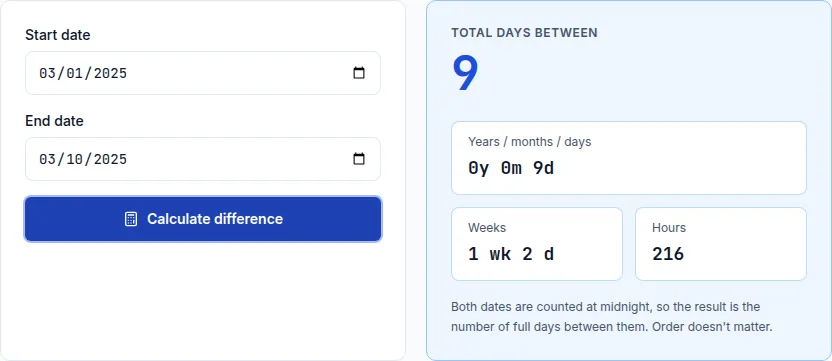
"How many days between March 1 and March 10?" sounds like a question with one obvious answer, but the real answer depends on something people rarely specify: whether you're counting the days between the dates, or the days spanned by them.
Inclusive vs. exclusive counting
Subtracting one date from another gives you the number of days between them — March 1 to March 10 is 9 days apart. But if you're counting how many days a stay, rental, or event spans (both the start and end day included), the answer is 10, not 9.
This exact ambiguity is why hotel bookings count 'nights' rather than 'days', and why rental agreements are usually explicit about whether the last day counts. When it isn't specified, assume the exclusive (subtraction) answer unless the context clearly calls for inclusive counting.
Why the math isn't just (end date − start date)
Calendar months don't have a fixed length, so a naive 'count the months' approach breaks down fast. Going from January 31 to March 1 is one month and one day on a calendar, but a rigid 30-day-month assumption would get this wrong. The reliable approach converts both dates into a single continuous count — days since a fixed reference point — and subtracts, which automatically handles uneven month lengths.
Leap years add another wrinkle: any date range crossing a February 29 has one extra day in it that a simplistic 365-day-year formula would miss entirely.
Common real-world uses
Beyond curiosity, exact date-difference math matters for: calculating interest that accrues daily, determining age in days for medical or legal contexts, figuring out how many days remain until a deadline, and settling disputes about contract terms that reference a specific day count.
Whenever the stakes are real — a legal deadline, an interest calculation — verify whether inclusive or exclusive counting applies before trusting a single number.
Put it into practice
The fastest way to learn the math is to play with the numbers.
Open the Date Difference Calculator