
3 min read · October 19, 2027
Round Trip Gas Cost: Don't Forget the Return Trip
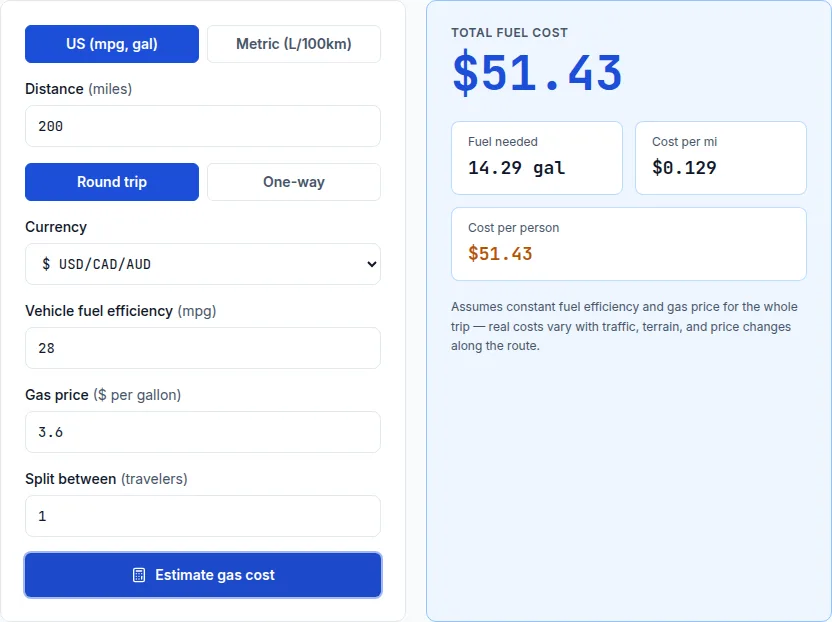
A 200-mile drive to a destination is a 400-mile round trip once you account for coming home — doubling the fuel cost from a one-way estimate. At 28 mpg and $3.60/gallon, that's $51.43 for the full round trip, not the $25.71 a quick one-way glance might suggest.
The easy mistake: budgeting only the trip there
It's a common planning slip to look up the distance to a destination, estimate gas for that distance, and mentally budget that number for the whole trip — forgetting the drive home is the same distance again. A 200-mile drive to visit family isn't a 200-mile trip; it's a 400-mile trip once the return leg is included, and the fuel cost doubles accordingly.
This calculator's round-trip toggle handles the doubling automatically once you enter the one-way distance — the 'round trip' setting simply multiplies the entered distance by 2 before running the rest of the math, so the number shown already reflects the full journey.
When one-way is actually the right setting
One-way is correct for a genuine single-direction trip — a one-time move, a drop-off where someone else drives the return leg, or splitting a trip's legs between different drivers or different vehicles where only one direction's cost matters to the person budgeting. For any trip where the same driver and vehicle make both legs, round trip is the setting that reflects reality.
Building this into a full trip budget
Gas is usually the most predictable line item in a road trip budget — real variability comes from lodging, food, and any detours or side trips that add mileage beyond the direct route. Adding a buffer of 10-15% to the calculated round-trip fuel cost is a reasonable hedge against unplanned detours, traffic that increases idle fuel consumption, or a gas price that's higher than expected at the actual stations along the route.
Related guides
Put it into practice
The fastest way to learn the math is to play with the numbers.
Open the Gas Price Travel Estimator