5 min read · October 13, 2026
Cooking Measurement Conversions: Why Grams Beat Cups, Plus Oven Temperatures
A cup of flour and a cup of honey weigh completely different amounts, which is why cup measurements cause more baking failures than any other conversion mistake. Weighing ingredients in grams is the fix, and it's also why serious recipes increasingly list gram weights instead of cup counts.
Why 'grams to cups' doesn't have one right answer
A cup is a unit of volume, but recipes usually care about weight — and how much a cup of something weighs depends entirely on how dense that ingredient is. A cup of all-purpose flour weighs roughly 125g, a cup of granulated sugar weighs roughly 200g, and a cup of honey weighs roughly 340g — three very different numbers for the same cup.
Even flour alone varies by how it's scooped: spooning flour into a measuring cup and leveling it gives a different weight than scooping directly from the bag and packing it down, sometimes by 20% or more. That variance is exactly why a kitchen scale beats a measuring cup for anything where the ratio of ingredients actually matters — bread and pastry especially.
Common baking weights worth memorizing
All-purpose flour: 1 cup ≈ 125g. Granulated sugar: 1 cup ≈ 200g. Brown sugar (packed): 1 cup ≈ 220g. Butter: 1 cup ≈ 227g (a standard US butter stick is 1/2 cup, 113g). Rolled oats: 1 cup ≈ 90g. These are close enough for most home baking, though exact values vary slightly by brand.
Liquid measurements convert more predictably since water-based liquids are close to the same density: 1 cup ≈ 240ml, 1 tablespoon ≈ 15ml, 1 teaspoon ≈ 5ml. The unreliability problem is specific to dry, dense, or fatty ingredients — not liquids.
Oven temperature: Fahrenheit, Celsius, and gas marks
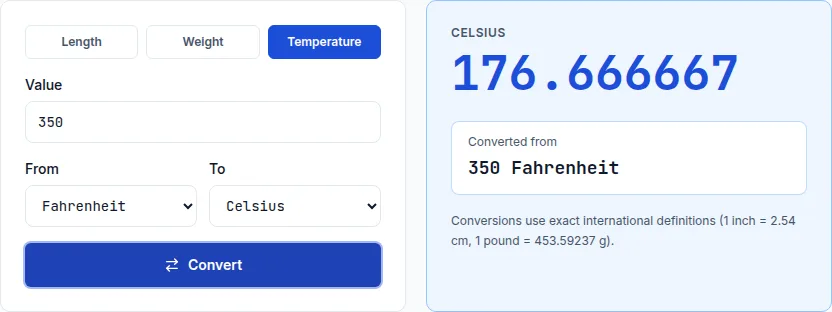
The formula is °C = (°F − 32) × 5/9, and °F = °C × 9/5 + 32. A 350°F recipe converts to 176.7°C, which most ovens and recipes round to 175°C or 180°C — the couple of degrees of rounding doesn't meaningfully affect baking. For a fan or convection oven, most conversion guides recommend lowering the target temperature by about 20°C (25°F) from what a conventional-oven recipe states.
UK recipes sometimes use gas marks instead of a temperature: gas mark 4 is roughly 180°C/350°F, and each mark up or down shifts by about 14°C (25°F). If a recipe only gives a gas mark, converting it to Celsius or Fahrenheit first makes it usable on any oven.
When cups are genuinely fine to use
For everyday cooking — soups, sauces, most savory dishes — the ratios are forgiving enough that cup measurements work perfectly well, and converting everything to grams is more effort than the recipe needs. The precision of weight matters most where chemistry is unforgiving: yeasted bread, laminated pastry, and delicate cakes, where being off by 20% on the flour can be the difference between a recipe working and not.
Related guides
Put it into practice
The fastest way to learn the math is to play with the numbers.
Open the Unit Converter