
4 min read · August 17, 2027
How Many A's Do You Need to Raise Your GPA?
The more credits you've already completed, the harder it is to move your GPA — a semester of straight A's lifts a 3.00 GPA with 9 credits completed far more than the identical semester lifts a 3.00 GPA with 90 credits completed, because new grades are always averaged against your entire academic history, not just the new term.
The formula behind raising a GPA
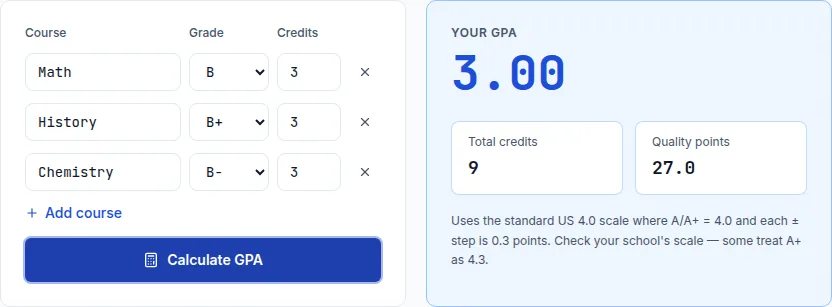
New GPA = (current GPA × current credits + new semester's GPA × new credits) ÷ (current GPA + new credits combined). Starting from a 3.00 GPA on 9 completed credits (the example above: a B, B+, and B-), adding a 12-credit semester of straight A's gives (3.00 × 9 + 4.00 × 12) ÷ (9 + 12) = (27 + 48) ÷ 21 = 3.57 — a substantial jump, because the new semester's credits (12) are a large fraction of the total (21).
The same all-A semester added to a student with 90 existing credits at a 3.00 GPA gives (3.00 × 90 + 4.00 × 12) ÷ 102 = (270 + 48) ÷ 102 = 3.12 — a real but far smaller lift, because 12 new credits barely move the average against 90 already-locked-in credits.
Why early semesters matter disproportionately
This is exactly why academic advisors emphasize a strong start: the same letter grade moves a freshman's GPA far more than it moves a senior's, purely because of how much accumulated history it's being averaged against. A rough early semester is also comparatively cheap to recover from — the fewer credits on the books, the more a strong following semester can pull the average back up.
By senior year, a low cumulative GPA becomes mathematically difficult to move significantly in the time remaining — which is why catching a downward trend early, rather than trying to fix it in a final semester or two, makes a measurably bigger difference.
Setting a realistic target
Plug your actual current GPA and credits into the formula above with a realistic (not aspirational) expected semester GPA to see where you'd actually land — a target that assumes straight A's when your realistic range is mostly B+/A- will overstate what's achievable and lead to a discouraging shortfall rather than a useful plan.
Put it into practice
The fastest way to learn the math is to play with the numbers.
Open the GPA Calculator