
3 min read · April 13, 2027
Dog Age in Human Years: The Real Formula (Not Just ×7)
The old 'multiply by 7' rule for converting dog years to human years is a myth — the actual science-backed formula is human age = 16 × ln(dog's age) + 31, developed from studying how dogs' DNA changes with age. A 5-year-old dog works out to 16 × ln(5) + 31 ≈ 56.8 human years, not the 35 the old ×7 rule would suggest.
Why the ×7 rule is wrong
The multiply-by-seven rule dates to the 1950s and was never based on real biological data — it's a round, memorable number, not a measurement. Dogs actually age fastest in their first couple of years and then slow down, which a flat 7-to-1 ratio can't capture: a 1-year-old dog is already sexually mature and roughly equivalent to a 15-year-old human under the real formula, nowhere close to the age the old ×7 rule would suggest.
The modern formula comes from research analyzing chemical changes in dogs' DNA over time (an 'epigenetic clock', similar to work done in human aging research) rather than an arbitrary ratio, which is why it captures the fast-then-slowing aging curve real dogs actually show.
The formula and a worked example
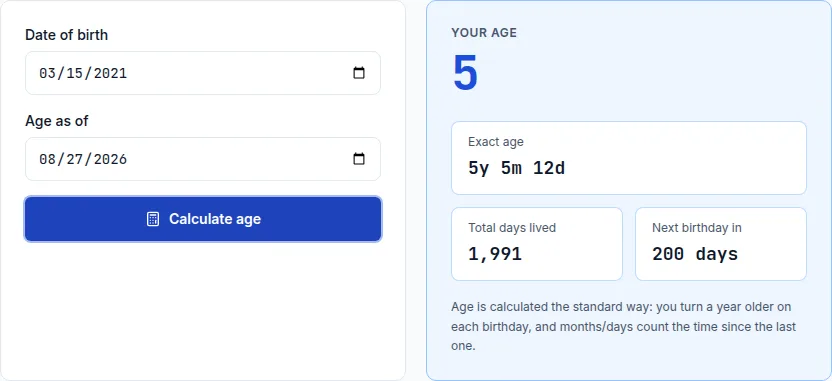
Human age = 16 × ln(dog's age in years) + 31, where ln is the natural logarithm. Get the dog's exact chronological age first — this calculator's total-days-lived figure divided by 365.25 gives age in years precisely; 1,991 days is 5.45 years.
Plugging in: 16 × ln(5.45) + 31 = 16 × 1.696 + 31 ≈ 27.1 + 31 = 58.1 human years. For comparison, a 2-year-old dog computes to 16 × ln(2) + 31 ≈ 42 human years, and a 10-year-old dog to 16 × ln(10) + 31 ≈ 67.8 — the curve flattens noticeably as the dog ages, unlike the straight-line ×7 rule.
The caveat: it was built on Labrador Retrievers
The research behind this formula primarily studied Labrador Retrievers, and breed size is known to affect aging rate in dogs — large breeds tend to age faster in later years than small breeds, a variable this single formula doesn't fully capture. It's a substantial improvement over the ×7 myth, but not a perfectly precise answer for every breed.
For a rough, breed-agnostic estimate, this formula is the best widely available option; for a specific breed's actual life expectancy and aging pattern, breed-specific veterinary guidance is more precise than any generic formula.
Related guides
Put it into practice
The fastest way to learn the math is to play with the numbers.
Open the Age Calculator