
3 min read · September 7, 2027
How to Calculate Age in Months (Not Just Years)
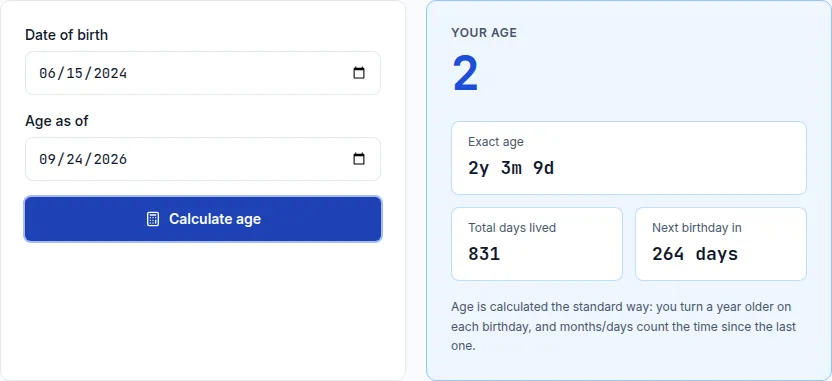
Age in months = (years × 12) + remaining months, calculated from the exact years/months/days breakdown between a birth date and today. A child who is 2 years, 3 months, and 9 days old is 27 months old (2 × 12 + 3), with 9 extra days beyond that.
Converting the standard breakdown to total months
A standard age calculator returns years, months, and days separately — 2y 3m 9d, for example. To get a single 'age in months' figure, multiply the years by 12 and add the leftover months: (2 × 12) + 3 = 27 months. The leftover days (9, in this example) are usually dropped or rounded, since 'age in months' is itself already an approximation more granular than years but less granular than exact days.
For a faster but slightly less precise estimate, total days lived ÷ 30.44 (the average month length) gives a close approximation — 831 total days ÷ 30.44 ≈ 27.3 months, matching the exact calendar-based calculation closely.
Why months matter more than years for babies and toddlers
Pediatric development milestones, vaccination schedules, and medication dosing are almost always specified in months for children under about 2-3 years old, because development changes so rapidly in that window that 'age in years' is far too coarse — the difference between a 14-month-old and an 18-month-old is developmentally significant in a way that rounding both to '1 year old' completely obscures.
This is exactly why pediatricians' growth charts, developmental milestone checklists, and dosing charts for young children are labeled in months rather than years well past the point where adults would naturally switch to counting in years.
When to switch back to years
Past roughly age 2-3, most contexts (school enrollment cutoffs, general conversation, most medical contexts for older children) switch back to counting in years, since the rate of developmental change has slowed enough that month-level precision stops being as meaningful. The exact cutoff varies by context — a pediatrician might track months longer than a school registrar would.
Related guides
Put it into practice
The fastest way to learn the math is to play with the numbers.
Open the Age Calculator